
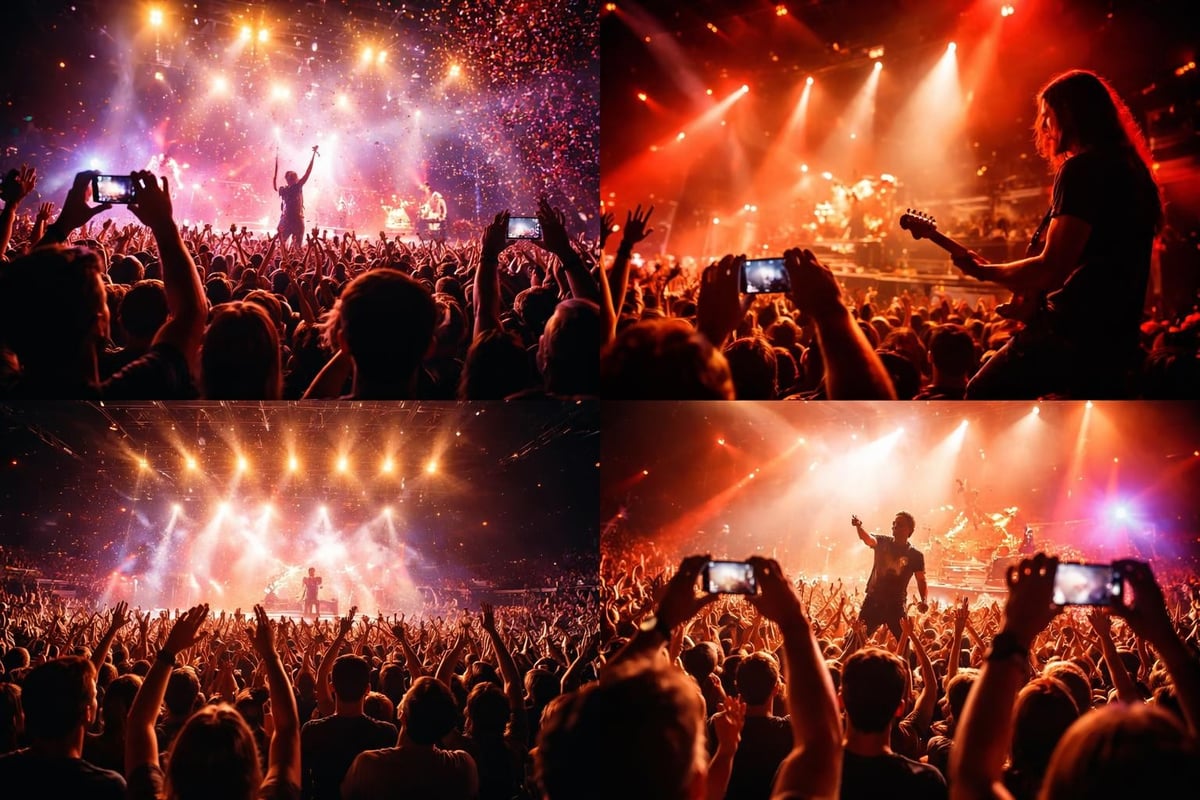
You've seen the slick, professionally shot concert videos. Perfect lighting, three-camera setup, production crew larger than some bands. They look great. They also cost a fortune and miss most of what actually happened. The best moments at live shows aren't always where the cameras are pointed. They're in the crowd, shot on phones, completely unplanned. That's where live concerts videos get interesting.
Why Attendee Footage Beats Professional Production
Professional video crews capture what they're told to capture. Attendees capture what moves them.
There's research backing this up. Social presence affects how people enjoy concert videos, meaning the connection viewers feel matters more than production quality. When someone in the crowd films because they're genuinely excited, that emotion transfers.
Here's what attendee footage gives you:
- Multiple perspectives from different spots in the venue
- Spontaneous reactions that can't be staged
- Content that feels like being there, not watching a documentary
- Zero production costs beyond your platform
- Immediate social sharing from people who were actually present
The live music industry is expanding rapidly, hitting $79.7 billion by 2030. Events are getting bigger, which means more attendees with phones in their pockets. That's not a problem to solve. It's an asset to use.
The Economics Actually Work
Let's talk numbers. A professional video crew for a festival runs $5,000 to $50,000 depending on scale. You get one perspective, one edit, one finished product.
With attendee-generated content, you're looking at these metrics:
| Traditional Production | User-Generated Approach |
|---|---|
| $5,000-$50,000 per event | Platform cost only |
| 1-3 camera angles | Dozens to hundreds of angles |
| Weeks for editing and delivery | Content shared during event |
| Limited organic reach | Built-in social distribution |
| One official narrative | Multiple authentic stories |
The content production costs drop to nearly nothing. Your main expense becomes curation and editing tools, which is where AI actually helps without faking anything.
Monetization That Makes Sense
Hybrid event monetization isn't just about selling virtual tickets anymore. It's about creating content assets that keep working after the show ends.
Live concerts videos from attendees give you:
- Licensing opportunities for festivals and venues
- Social proof that drives next year's ticket sales
- Sponsor visibility in organic content
- Archive material for documentary projects
- Marketing assets that cost nothing to produce
When people share their own footage, they're not just promoting your event. They're vouching for it. That's worth more than any ad buy.
Content Volume vs. Content Value
You'll get a lot of footage. Most of it won't be great. That's fine.
The ratio works like this: if 500 people attend and 100 film something, maybe 30 capture genuinely good moments. Out of those, 10-15 pieces will be share-worthy. That's still 10-15 authentic clips you didn't have to produce.
What makes concert footage actually good:
- Clear audio of the performance, not just crowd noise
- Stable enough to watch without motion sickness
- Captures a complete moment, not just three seconds
- Shows something unique (crowd reaction, special moment, artist interaction)
- Isn't just someone's arm blocking the view
The best content curation platforms filter this automatically. You're not manually sorting through hundreds of clips. AI handles the technical screening. Humans make the final call on what represents your event well.

Platform Requirements That Actually Matter
You need specific capabilities to make this work. Not nice-to-haves. Essentials.
Collection Infrastructure
Getting footage from attendees requires zero friction. They're not going to download an app, create an account, verify their email, and then maybe upload something. They'll just post to their own Instagram instead.
Your mobile app needs to work like this:
- Scan a QR code to join
- Upload directly from camera roll
- Automatic consent management
- Immediate confirmation their content was received
That's it. Anything more complex and participation drops by half.
Rights Management
Here's where most event organizers mess up. They collect footage without clear content licensing agreements. Then they want to use it for marketing and realize they can't prove anyone gave permission.
| What You Need | Why It Matters |
|---|---|
| Explicit upload consent | Legal protection for use |
| Commercial rights clarity | Ability to monetise |
| Attribution tracking | Credit original creators |
| Revocation process | Compliance with privacy laws |
| Age verification | COPPA and GDPR requirements |
Consent management isn't exciting, but it's what separates usable content from legal liability.
Streaming Doesn't Kill Live (It Helps)
There's this myth that if you share concert footage online, people won't buy tickets. Research shows streaming platforms actually stimulate demand for live performances.
People see authentic footage and want to experience it themselves. Live concerts videos work as marketing, not competition.
Think about festival announcements. Which generates more ticket sales: a polished promotional video or fifty clips from last year's attendees showing how much fun they had? The second one. Every time.
Virtual Components Add Revenue
Virtual concert platforms are growing through 2035, but they're not replacing in-person events. They're complementing them.
You can:
- Sell livestream access to people who can't attend
- Create highlight packages for premium content subscribers
- Offer virtual VIP experiences with multi-angle views
- Build year-round community with archived content
The attendee footage makes this possible without hiring a broadcast team.
Distribution Happens Automatically
Professional concert videos sit on your website or YouTube channel hoping someone finds them. User-generated content spreads through personal networks immediately.
How organic reach actually works:
- Attendee films moment they love
- They upload to your platform AND share to their socials
- Their followers see authentic experience
- Some followers become interested in your next event
- They bring their friends
- Those friends film their own moments
- Cycle repeats with larger audience
This is earned media that compounds. Each event generates more content creators for the next one.
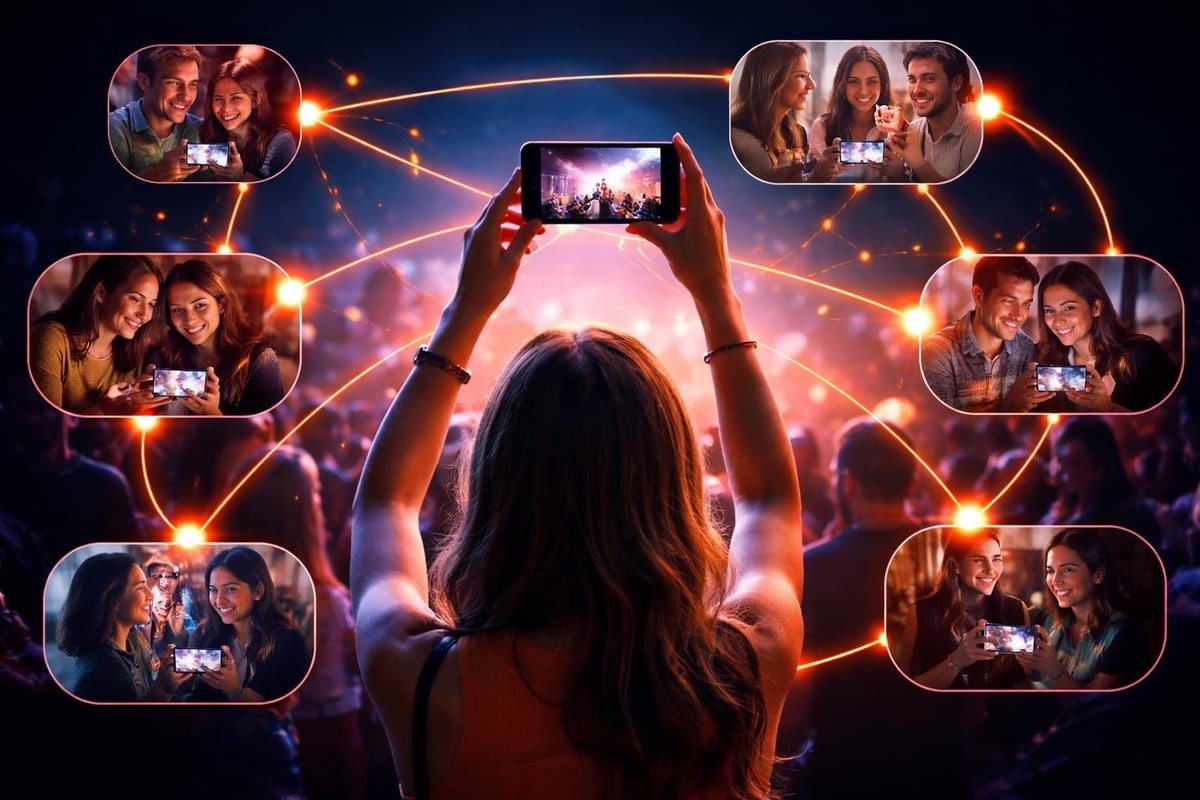
The platform features you need here are simple: one-click sharing to major social platforms with your event branding embedded. Not overlaid like a watermark. Actually embedded in the metadata.
What AI Does (And Doesn't Do)
AI doesn't create your content. Your attendees do that. AI helps you find the good stuff and make it better.
Useful AI applications for live concerts videos:
- Quality screening: Filters out footage too dark, shaky, or short to use
- Audio analysis: Identifies clips with clear performance audio vs. just crowd noise
- Duplicate detection: Removes multiple uploads of the same moment
- Smart cropping: Reformats horizontal footage for vertical social platforms
- Scene detection: Finds clips that capture complete moments, not fragments
- Rights matching: Connects footage to verified attendee permissions
None of this generates fake content. It processes real footage faster than humans can.
Some platforms are experimenting with AI-enhanced concert experiences that translate chat into audience reactions for VR. That's interesting for virtual events but completely separate from what we're discussing.
Technical Specs You Can't Ignore
Attendees shoot on phones. Phones have gotten remarkably good, but the footage still needs processing.
Format Standardization
You'll receive:
- Different resolutions (720p to 4K)
- Different frame rates (24fps to 60fps)
- Different orientations (vertical, horizontal, square)
- Different codecs (H.264, HEVC, others)
Your system needs to normalize this without degrading quality. H.264 vs H.265 matters when you're storing hundreds of clips. HEVC gives you better compression without quality loss.
Storage and Bandwidth
A three-day festival with 10,000 attendees might generate 2,000 video uploads. At an average of 100MB per clip, that's 200GB. Manageable, but only if your infrastructure is built for it.
Cloud storage costs run about $0.023 per GB monthly. That's $4.60 per month for one festival's content. Bandwidth for uploads and streaming access costs more, around $0.09 per GB transferred. Do the math before you promise unlimited uploads.
The Community Aspect Nobody Talks About
When you build a brand community around your events, content becomes currency. People who contribute great footage become known within that community.
Give them recognition:
- Feature their clips on official channels with credit
- Offer perks for top contributors (early ticket access, backstage passes)
- Create annual awards for best user content
- Build galleries where they can showcase their festival portfolio
This turns casual attendees into brand advocates who actively document your events. They're not doing it for payment. They're doing it for status within a community they value.
The use cases extend beyond just marketing. You're creating a documented history of your events through the eyes of people who were there.
Privacy and Safety Considerations
Collecting live concerts videos means filming crowds. That includes people who didn't consent to be filmed.
Your policy needs to address:
- Clear signage that filming is happening
- Easy opt-out for people who don't want to appear in content
- Face blurring options for background individuals
- Age restrictions for featured content
- Takedown process if someone appears without permission
This isn't optional. GDPR compliance and similar privacy regulations require it. Get it wrong and the fines eliminate any cost savings.
Most platforms handle this with automated face detection and manual review flags. If someone requests removal, you need infrastructure to find and remove all instances of their appearance. Build that capability from day one.
Making Short-Form Content Work
Short-form video dominates social platforms. Your attendee footage needs to work in that format.
Concert clips naturally fit 15-60 second formats. The challenge is making them compelling without the full context of being there.
What works:
- Peak moments (drop, chorus, crowd singalong)
- Artist interaction with specific audience members
- Unexpected events (guest appearances, technical moments turned positive)
- Genuine emotional reactions
- Visual spectacle (lights, effects, stage production)
What doesn't:
- Long instrumental sections
- Sound check footage
- Crowd conversations
- Generic stage shots without context
- Shaky panning across the venue
Your curation process should prioritise clips that work standalone. Even if the full performance was great, individual clips need their own story arc.
Integration With Existing Workflows
You're probably already promoting events through multiple channels. User-generated live concerts videos slot into that without replacing anything.
Pre-event: Share highlights from previous years to build anticipation
During event: Feature real-time uploads to event screens and social feeds
Post-event: Create recap content and year-round engagement
The content feeds your existing marketing calendar. You're not creating new distribution channels. You're filling existing ones with authentic material.
Most event video strategies rely on planned content. This supplements it with unplanned moments that make events memorable.
Measuring What Actually Matters
Vanity metrics (views, likes) don't tell you if this works. Track these instead:
| Metric | What It Tells You |
|---|---|
| Upload participation rate | Attendee engagement level |
| Social shares per clip | Content resonance |
| Traffic from UGC to ticket sales | Actual conversion impact |
| Content reuse frequency | Long-term asset value |
| Contributor return rate | Community strength |
If 10% of attendees contribute content and that content drives 5% of next event's ticket sales, you've got a system that pays for itself. If not, adjust what you're encouraging people to film or how you're featuring it.
Live concerts videos from attendees give you authentic documentation that costs almost nothing and spreads organically. The technical barriers are gone. What's left is building systems to collect, curate, and distribute content from people who were actually there. SureShot handles the collection and curation infrastructure so event organizers can focus on the experience itself, turning attendees into storytellers whose footage becomes your most effective marketing asset.