
How to Build a Brand Community: Steps, Tools, and Examples
Your customers already talk about your brand. They share photos, post videos, tag your events, and swap stories with friends. But most brands watch this happen from the sidelines, treating these moments as nice-to-have bonuses rather than strategic assets. The result? You miss opportunities to turn casual fans into devoted advocates who promote your brand without being asked.
Building a brand community solves this. When done right, it transforms scattered customer interactions into a structured network where people connect over shared interests, support each other, and actively participate in your brand's story. The payoff includes lower marketing costs, authentic content, and customers who stick around longer.
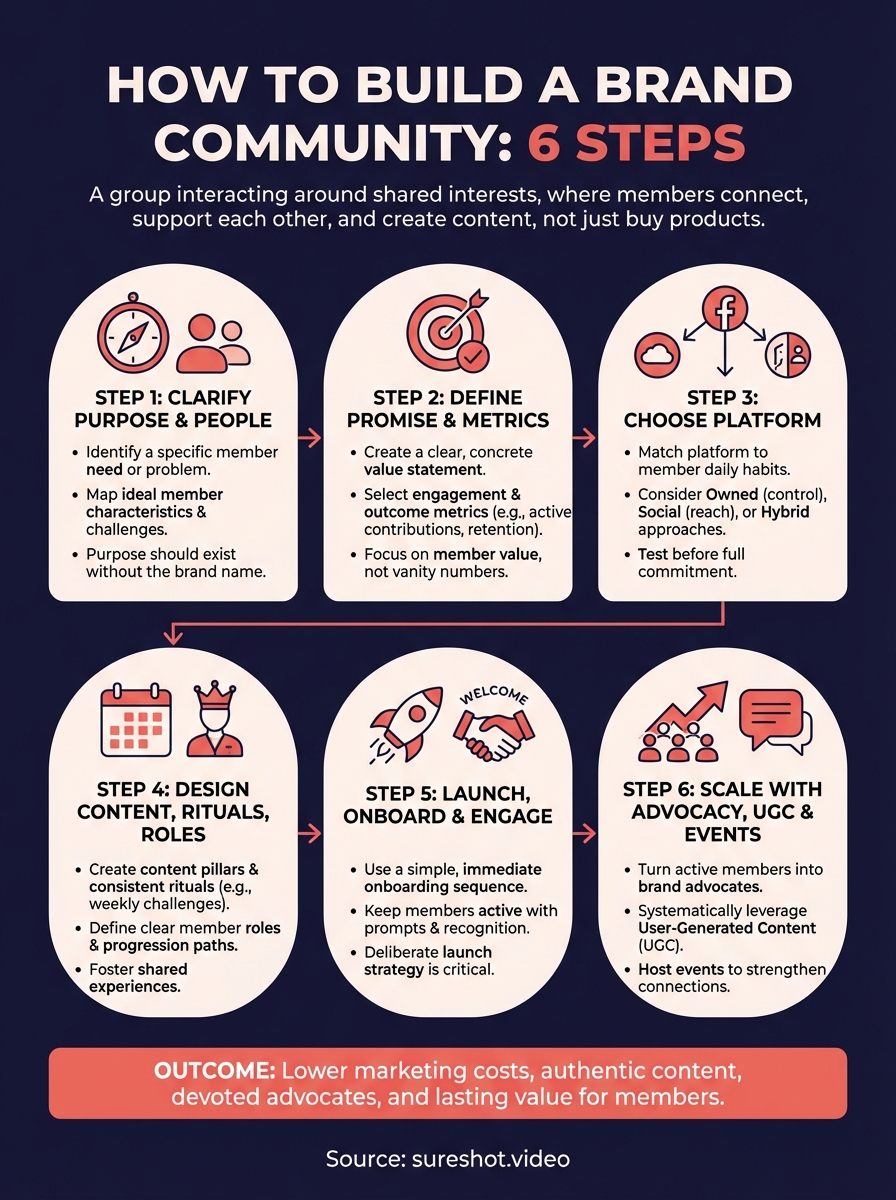
This guide walks you through six practical steps to build your brand community from scratch. You'll learn how to define your community's purpose, choose the right platform, design engaging experiences, and scale through advocacy and user-generated content. We'll also share specific tools and real examples from brands that got it right, so you can avoid common mistakes and build something that actually works.
What a brand community is and is not
A brand community is a group of people who regularly interact around shared interests connected to your brand. These people don't just buy from you; they engage with each other, create content, share experiences, and help fellow members solve problems. The relationships between members matter just as much as their relationship with your brand itself.
What defines a real brand community
Real communities have three core elements that separate them from basic customer groups. First, members identify with the community and feel a sense of belonging that goes beyond product ownership. Second, they participate in shared rituals, whether that's attending regular events, using specific language, or following community traditions. Third, they support each other through advice, encouragement, and shared resources without needing your team to prompt every interaction.

You'll know you have a genuine community when members connect directly with each other and when conversations happen without your constant involvement. People post questions and other members answer. They organise meetups on their own. They create content that celebrates the community itself, not just your products. This organic interaction is what separates a thriving community from a marketing channel dressed up with community language.
When members talk to each other more than they talk to your brand, you've built something real.
What brand communities are not
Brand communities are not social media follower counts. You can have 100,000 Instagram followers without a single meaningful connection between those people. They scroll, they like, they move on. That's an audience, not a community. Similarly, communities aren't email lists where you broadcast messages and people passively receive them.
They're also not customer service channels disguised as discussion forums. If your "community" exists solely so customers can report bugs and request support while you respond, you've built a help desk. The difference matters because learning how to build a brand community requires fostering member-to-member relationships, not just brand-to-customer transactions.
Finally, communities aren't quick wins. You can't buy a community platform, invite customers, and expect magic within weeks. Building authentic connections takes consistent effort over months and years. Brands that treat communities as short-term campaigns typically see members disappear once the initial excitement fades. Your goal is creating lasting value for members themselves, not extracting immediate marketing ROI.
Step 1. Clarify your purpose and people
Before you create any platform or post any content, you need to answer two fundamental questions: what purpose will your community serve and who exactly will it serve. These decisions shape everything else, from your platform choice to your content strategy. Many brands skip this step and wonder why their communities feel empty or attract the wrong people.

Identify why your community exists
Your community needs a clear reason for existing beyond "because other brands have one." Start by identifying a specific need, problem, or interest that connects your target members. SureShot's community, for example, exists because event organizers need easier ways to collect and share authentic video content from attendees while building loyalty.
Write down three to five specific benefits members will gain by participating. These should focus on member value, not brand value. Good examples include learning new skills, getting answers to tough questions, finding collaboration partners, or accessing exclusive resources. Weak examples sound like "increase brand awareness" or "drive more sales" because those serve you, not members.
The strongest communities solve real problems that members can't easily solve alone.
Test your purpose by asking: would people join even if we removed the brand name? If your answer is no, you haven't identified a strong enough purpose. Event organizers would still value a community focused on leveraging attendee content regardless of which company hosts it.
Map your ideal community members
List specific characteristics of people who will benefit most from your community. Include their roles (event marketing managers, festival organizers), their current challenges (lack of authentic content, high production costs), and their goals (increase social media reach, reduce expenses). The more specific you get, the easier you'll find and attract the right people.
Create a simple profile template:
Role: Festival Marketing Director
Current challenge: Needs authentic video content but can't afford professional crews
Goal: Build social proof and extend event reach through attendee videos
Where they spend time: LinkedIn groups, event industry conferences, Reddit's r/eventplanning
Answer this for two to three distinct member types rather than trying to serve everyone. When you understand exactly who you're building for, every subsequent decision about how to build a brand community becomes clearer and more effective.
Step 2. Define your community promise and metrics
Your community needs a clear value statement that tells potential members exactly what they'll gain by participating. This statement becomes your north star, guiding every decision about content, features, and priorities. Without it, you'll struggle to attract the right people and keep them engaged. Equally important, you need to establish specific metrics that measure whether your community delivers on that promise.
Create your community value statement
Write a simple, concrete sentence that describes the primary benefit members receive. This isn't a tagline or marketing copy. It's an internal commitment that shapes how you build and run the community. For SureShot's target audience, a strong value statement might read: "Event organizers get practical strategies and tools to collect authentic attendee video content that reduces production costs and increases social reach."
Your statement should pass the specificity test. Ask yourself: could any brand say this, or is it genuinely tied to your unique position? Generic statements like "connect with like-minded people" fail this test. Specific ones like "master attendee-generated video strategies for festivals and concerts" succeed because they define both the outcome and the context.
The clearer your promise, the easier it becomes to deliver value consistently.
Test your statement by sharing it with five potential members and asking if it resonates with a real need they have. If they immediately understand the benefit and see themselves participating, you've nailed it. If they look confused or uninterested, refine until the value clicks.
Select metrics that matter
Choose three to five metrics that directly reflect member value, not just vanity numbers. When learning how to build a brand community, most people track the wrong things. Follower counts and page views look impressive but tell you nothing about whether members actually benefit from participating.
Focus on engagement and outcome metrics instead:
| Metric Type | Example | Why It Matters |
|---|---|---|
| Active participation | Monthly active contributors posting questions or answers | Shows members find the community useful enough to engage |
| Member retention | Percentage of members still active after 90 days | Indicates sustained value delivery |
| Peer interactions | Ratio of member-to-member responses versus brand-to-member | Proves community exists beyond your team's efforts |
| Content creation | Number of user-generated posts, videos, or resources shared | Demonstrates members feel invested enough to contribute |
| Problem resolution | Average time for members to get helpful answers | Confirms the community solves real needs |
Track these metrics monthly at minimum and adjust your approach when numbers decline. If active participation drops, your content or format might miss the mark. If retention falls, members aren't getting lasting value. Your metrics tell you whether you're keeping your community promise.
Step 3. Choose where your community will live
Your platform choice directly impacts how easily members can participate and whether they'll return regularly. The right platform matches where your target members already spend time and supports the type of interactions your community needs. The wrong choice creates friction that kills engagement before your community gains momentum. You face three main platform categories, each with distinct strengths and limitations.
Platform types and trade-offs
Owned platforms give you complete control over features, data, and member experience. You build a dedicated website or use white-label community software like Circle or Discourse. This option works best when you need custom functionality, want to own all member data, or plan to deeply integrate the community with your existing systems. The downside is higher setup costs and the challenge of driving members to yet another destination they need to remember to visit.

Social platforms like Facebook Groups, LinkedIn, or Discord reduce barriers because members already use these tools daily. You get built-in notifications and familiar interfaces that require zero learning curve. Facebook alone hosts millions of active groups, proving people will engage when the platform fits their habits. However, you surrender control over algorithm changes, face platform restrictions on features, and compete with infinite distractions. You also can't easily migrate if the platform changes direction or shuts down.
Hybrid approaches combine owned spaces with social platform presence. You might host deep discussions and resources on your website while using social platforms for quick updates and discovery. This strategy works when learning how to build a brand community around complex topics that benefit from structured, searchable archives plus casual daily interaction.
| Platform Type | Best For | Main Challenge |
|---|---|---|
| Owned (Circle, Mighty Networks) | Full control, custom features, data ownership | Getting members to visit regularly |
| Social (Facebook Groups, Discord) | Easy access, daily engagement | Limited control, platform dependency |
| Hybrid (Website + Social) | Maximum reach and depth | Managing multiple spaces consistently |
Match platform to member behavior
Research where your specific audience already congregates. Survey potential members or check where similar communities thrive. Event marketing professionals might prefer LinkedIn for credibility and networking, while younger festival organizers might choose Discord for real-time collaboration during events. Your platform should fit naturally into their existing routines, not force them to adopt new habits.
Pick the platform your members check daily, not the one with the most features.
Consider what actions members need to take in your community. If they'll primarily share videos and photos, visual platforms like Instagram or a custom video-friendly site make sense. For SureShot's audience sharing event video strategies, a platform supporting rich media embeds and threaded discussions serves better than text-only forums. Test your top two choices with a small pilot group before committing fully.
Step 4. Design content, rituals, and roles
Your community needs structured experiences that bring members back repeatedly. Random posts and occasional updates won't build habits or deepen connections. Instead, you need a deliberate mix of content types, recurring rituals, and clear roles that help members participate at different levels. This step transforms your community from a static space into a living ecosystem where people know what to expect and how they fit in.
Create a content framework
Design three to five content pillars that directly support your community promise. Each pillar represents a content category that delivers specific member value. For event organizers learning how to build a brand community around attendee video content, your pillars might include: attendee video collection strategies, content licensing and rights management, social media amplification tactics, AI-assisted content curation, and community building through UGC.
Within each pillar, alternate between content formats to match different learning styles and time commitments. Mix quick tips, detailed case studies, template resources, live discussions, and member spotlights. A weekly content calendar might look like:
Monday: Quick video strategy tip (2 minutes)
Wednesday: Member showcase featuring successful campaign
Friday: Template drop (release form, event PIN setup guide)
Monthly: Live Q&A with industry expert
Consistency matters more than volume. Members develop participation habits when they know what to expect and when. Start with one or two reliable content types before expanding. Quality beats quantity every time.
Establish community rituals
Rituals create shared experiences that strengthen member identity and belonging. These are regular, repeatable activities that members anticipate and participate in together. Start with simple rituals you can sustain long-term, then add more as your community grows.
Examples of effective rituals include weekly challenges where members share their latest event video wins, monthly themed discussions around specific event types, quarterly virtual meetups for real-time collaboration, or annual celebrations recognising top contributors. SureShot could launch "Video Victory Fridays" where members post their best attendee-captured moments from recent events.
Rituals work because they give members predictable reasons to return and participate.
Design rituals around your members' natural rhythms. Event organizers might engage most heavily in planning seasons (January-March, August-September) and need different support during active event periods. Match your ritual timing to when members can actually participate.
Define member roles and progression
Members want clear paths for increasing involvement. Create a simple role structure that recognizes different participation levels and contributions. This structure helps newcomers see how they can grow while giving experienced members leadership opportunities.
| Role Level | Requirements | Privileges |
|---|---|---|
| Observer | Joined community | Can view all content, ask questions |
| Contributor | Posted 5+ helpful responses | Can create discussion threads, share resources |
| Expert | 50+ contributions, proven expertise | Can host sessions, featured prominently |
| Ambassador | Nominated by community managers | Early access to features, direct input on roadmap |
Make progression visible and achievable. Display member levels on profiles and celebrate promotions publicly. When members see others advancing, they understand the pathway and feel motivated to contribute more. Your role structure shouldn't feel exclusive but rather invite everyone to participate at their comfort level.
Step 5. Launch, onboard, and keep people engaged
Your community platform is ready, your content framework exists, and your rituals are defined. Now comes the critical launch phase where you welcome your first members and establish participation patterns that either stick or fade. Most communities lose momentum within the first 30 days because they skip structured onboarding and fail to trigger early engagement. You need a deliberate launch strategy that transforms new joiners into active participants quickly.

Create a simple onboarding sequence
New members need immediate clarity about what to do next when they join. Without direction, they browse briefly and disappear. Build a three-step onboarding sequence that activates members within their first week.
Your sequence should guide members through these specific actions:
Day 1: Welcome message with community rules and value reminder
Day 2: Prompt to introduce themselves in a dedicated thread
Day 3: Encourage first question or response to existing discussion
Day 5: Share a quick-win resource (template, guide, or video)
Day 7: Invite to upcoming ritual (challenge, Q&A, or event)
Automate these messages when possible but personalize the tone to feel human, not robotic. For event organizers learning how to build a brand community around video content, your Day 3 prompt might ask: "What's your biggest challenge collecting video from attendees?" This question is specific, easy to answer, and immediately relevant to their needs.
The faster members contribute something, anything, the more likely they'll return.
Keep members active with prompts and recognition
Sustained engagement requires regular participation triggers that remind members why they joined. Post weekly discussion prompts tied to your content pillars, ask for feedback on templates or strategies, and highlight member wins publicly. Recognition drives continued participation when people see their contributions valued.
Create a simple recognition framework that celebrates different contribution types:
| Recognition Type | Trigger | Action |
|---|---|---|
| First Post | Member shares first contribution | Public welcome and thank you |
| Problem Solver | Provides helpful answer | Tag as "Helpful" with notification |
| Content Creator | Shares resource or case study | Feature in weekly highlight post |
| Consistent Contributor | 10+ quality contributions | Upgrade role, announce publicly |
Schedule weekly engagement blocks where you dedicate 30 minutes to prompting discussions, responding to questions, and recognising contributors. Consistency matters more than perfection. Members notice when communities feel active versus abandoned. Post something valuable every few days at minimum, respond to member content within 24 hours, and maintain your promised rituals without fail.
Direct messages work when public participation stalls. Reach out individually to quiet members with personalized prompts like: "I noticed you're an event planner in Austin. Would you share how you approach attendee content at outdoor festivals?" Personal invitations convert lurkers into contributors far more effectively than generic public posts.
Step 6. Scale with advocacy, UGC, and events
Once your community gains momentum with consistent participation and strong rituals, you're ready to scale through structured programs that multiply your impact without proportionally increasing your workload. Scaling means empowering members to recruit others, generate content on your behalf, and strengthen connections through shared experiences. The three most effective scaling methods are advocacy programs, systematic user-generated content, and strategic events.
Turn active members into brand advocates
Your most engaged members already recommend your brand informally. Formalize this enthusiasm into an advocacy program that recognizes and rewards members who actively promote your community and products. Start by identifying members who consistently contribute quality content, help others solve problems, and demonstrate genuine passion for your mission.
Create a simple advocate framework with clear expectations and meaningful benefits:
What advocates do: Share community wins on social media, invite qualified peers to join, mentor new members, provide product feedback, speak at events
What advocates receive: Early access to features, exclusive training sessions, co-marketing opportunities, public recognition, direct line to leadership
When learning how to build a brand community that grows organically, advocates become your most valuable asset because their recommendations carry authentic credibility that paid advertising cannot match. For SureShot, event organizers who successfully collect attendee video content make perfect advocates because they have real proof points to share with peers facing identical challenges.
Members who advocate from personal success stories convert prospects far better than your marketing team ever could.
Leverage user-generated content systematically
Request and repurpose specific types of content that serve both member needs and your marketing goals. Rather than hoping members randomly share useful material, prompt them with structured requests. Ask members to submit case studies showing results, short video testimonials explaining benefits, before-and-after examples demonstrating transformations, or templates and resources others can use immediately.
Build a UGC collection system where members easily submit content through forms or designated channels, you quickly review and approve submissions, and you redistribute approved content across your marketing channels with proper attribution. Always credit creators publicly and celebrate their contributions to encourage continued sharing.
Host events that strengthen connections
Events transform digital relationships into deeper personal connections that significantly increase retention and advocacy. Schedule quarterly virtual events where members collaborate in real time, annual in-person gatherings at industry conferences where members meet face-to-face, and monthly skill-building workshops that deliver immediate practical value.
Effective event formats include panel discussions featuring successful members, hands-on working sessions solving real problems together, networking sessions with structured introductions, and celebration events recognising top contributors. Track attendance and follow-up engagement to identify which event types resonate most with your specific members, then double down on formats that drive lasting participation increases.
Tools and real examples to learn from
You need both practical tools that simplify community management and real-world examples that show what success looks like in action. The right tools reduce your workload while improving member experience, letting you focus on relationships instead of logistics. Studying successful communities reveals patterns you can adapt to your specific audience and goals, avoiding expensive trial and error along the way.
Platform and management tools
Community platforms provide the foundation for hosting discussions, sharing content, and tracking engagement. Circle and Mighty Networks offer all-in-one solutions with member profiles, discussion forums, course hosting, and event management built in. These platforms work best when learning how to build a brand community from scratch because they eliminate technical complexity and provide proven templates you can customise quickly.
Slack and Discord excel for real-time communication where members need immediate responses and ongoing conversations. Event organizers often prefer these platforms during active event periods when quick coordination matters more than searchable archives. Both tools offer free tiers that work well for communities under 500 members, with paid plans adding features like unlimited message history and advanced permissions.
Engagement and analytics tools help you understand participation patterns and identify what works. Most platforms include basic analytics, but dedicated tools like Orbit or Common Room provide deeper insights into member journeys, contribution patterns, and relationship strength. You can track who connects new members, which content drives discussions, and when participation drops.
| Tool Category | Options | Best Use Case |
|---|---|---|
| All-in-one platforms | Circle, Mighty Networks, Discourse | Structured communities with courses and resources |
| Real-time chat | Slack, Discord | Fast coordination and casual daily interaction |
| Social platforms | Facebook Groups, LinkedIn Groups | Reaching members where they already spend time |
| Analytics | Orbit, Common Room, native platform tools | Understanding engagement and member journeys |
Brand communities that got it right
Notion's community demonstrates how empowering members to create value for others drives explosive growth. The company built an ecosystem where users share templates, tutorials, and use cases with minimal company involvement. Their template gallery attracts millions of visits annually, with top creators earning income from premium templates. Notion provides the platform and basic structure but trusts members to define what's valuable and how to share it.
Lego Ideas shows how structured member contribution programs can generate both community engagement and business value. Members submit original designs, other members vote on submissions, and winning designs become official products with creators receiving royalties. This ritual gives everyone clear roles (designer, voter, buyer), creates anticipation through regular review cycles, and proves the company values member input enough to stake real money on it.
When members see their contributions turn into tangible products or featured content, participation becomes personally meaningful.
Sephora's Beauty Insider Community blends commerce with genuine peer support. Members share product reviews, post beauty questions, and create mood boards without constant brand intervention. The community includes over 40 million members who contribute millions of product reviews annually, providing authentic social proof that influences purchase decisions. Sephora supports this by recognising helpful contributors, organising themed challenges, and ensuring questions get answered quickly, but the value comes from member-to-member interaction.
Peloton built their community around shared struggle and achievement. Members track workouts, compete on leaderboards, and encourage each other through difficult sessions. The company facilitates connection through features like high-fives during rides, milestone celebrations, and hashtag groups, but the emotional bonds form through suffering and succeeding together. This model works because fitness inherently includes both individual challenge and social motivation.
SaaS company HubSpot runs a massive community combining education, networking, and support. Their platform includes certification courses, user forums, local user groups, and an annual conference. Members progress from learners to experts to advocates, with clear recognition at each stage. HubSpot invests heavily in content, events, and member success because the community drives product adoption, reduces support costs, and generates authentic testimonials that close new deals.
Next steps for your brand community
You now understand how to build a brand community from initial planning through scaling. Your next action depends on where you currently stand. If you haven't started, begin with step one by defining your community purpose and ideal members before choosing any platform or creating content. This foundation prevents wasted effort building something nobody actually needs.
Already running a community that feels stagnant? Audit your current approach against the six steps outlined here. Most struggling communities fail because they skipped purpose clarification, lack consistent rituals, or focus on broadcasting instead of facilitating member-to-member connections. Fix the weakest link first rather than adding more features or content.
For event organizers specifically, video content from attendees offers unique community-building opportunities. When attendees share authentic moments from your events, they naturally create connections with each other and strengthen their bond with your brand. Book a demo to see how SureShot helps collect and leverage this content systematically.