


How Content Curation for Social Media Works: Steps + Tools
You know you need to post regularly on social media to stay visible and relevant. But creating fresh original content every single day is exhausting. You run out of ideas. Your team runs out of time. And hiring professional creators to fill the gaps gets expensive fast.
Content curation solves this problem. Instead of creating everything from scratch, you find and share valuable content that already exists. Think of it as being a trusted filter for your audience. You discover great articles, videos, and posts from other sources, add your perspective, and share them with your followers. This keeps your feed active and interesting without burning through your content budget.
This guide walks you through exactly how to curate content for social media. You'll learn what content curation actually is, how to set up a system that works, which sources to tap into, and how to measure what content resonates with your audience. We'll also share practical tools that make the curation process faster and easier.
What content curation for social media is
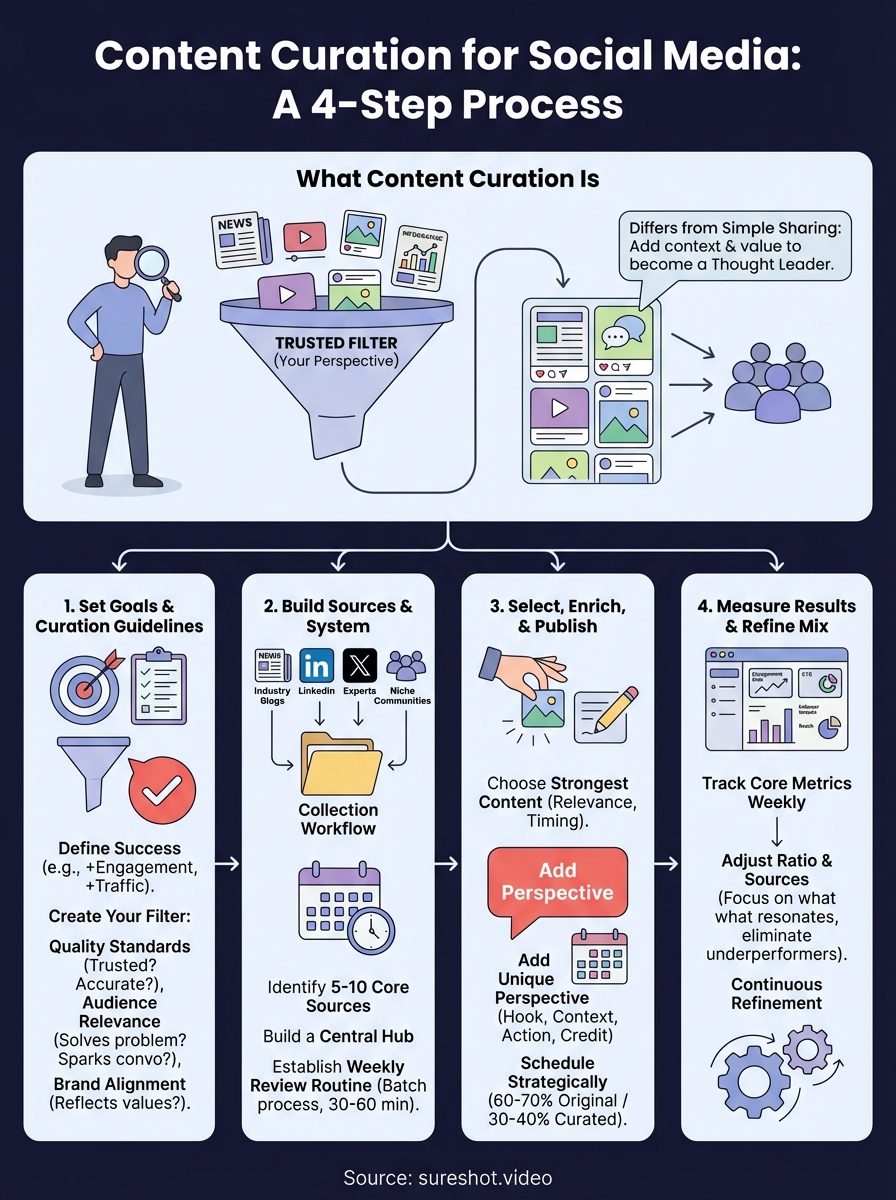
Content curation for social media means you collect, organise, and share valuable content from other sources with your audience. You become a trusted curator who filters through the noise and presents the best articles, videos, infographics, and posts that align with your brand and serve your followers' needs. This differs from content creation, where you build everything from scratch.
How curation differs from simple sharing
When you curate content, you add your own perspective to each piece you share. You might write a brief commentary explaining why the content matters, highlight a specific insight, or connect it to current events in your industry. This transforms you from a simple content aggregator into a thought leader who interprets and contextualizes information for your audience.
The best content curation combines carefully selected third-party material with your unique voice and expertise.
What curation looks like in practice
Picture an event organizer who shares a festival safety guide from a trusted source, then adds their own tips based on years of running events. Or a marketing manager who posts a social media trends report with specific examples of how their team will implement those trends. You find the valuable content, filter it through your expertise, and present it in a way that directly benefits your followers. This approach keeps your social channels active while establishing you as someone who consistently delivers useful information.

Step 1. Set your goals and curation guidelines
Before you start collecting content, you need to define what you want to achieve through curation and which types of content will actually serve those goals. Without clear objectives, you'll waste time sharing random posts that don't move your business forward. Your curation strategy should directly support your broader social media marketing goals, whether that's building thought leadership, driving website traffic, or keeping your community engaged between your own announcements.
Define what success looks like
Start by identifying 2-3 specific outcomes you want from your curated content. An event organizer might aim to increase ticket sales by 15% through sharing industry insights that position their events as must-attend experiences. A marketing team might focus on boosting engagement rates by 25% through curating trending topics their audience cares about. Write down your goals and attach measurable targets to each one so you can track whether your curation efforts actually work.
Clear goals transform content curation for social media from a time-filling exercise into a strategic business tool.
Create your curation filter
You need a simple framework that helps you quickly decide which content deserves your audience's attention. Build a decision checklist that includes these elements:

Content quality standards:
- Does this come from a trusted, authoritative source?
- Is the information accurate and up-to-date?
- Would I recommend this to a friend or colleague?
Audience relevance criteria:
- Does this solve a problem my audience faces?
- Will this spark conversation or provide value?
- Does this align with topics my followers care about?
Brand alignment questions:
- Does this reflect our values and expertise?
- Can I add meaningful commentary to this?
- Will sharing this strengthen or weaken our position as industry experts?
Save this checklist where your team can access it. Every piece of content you consider sharing should pass through this filter. This prevents you from cluttering your feed with content that looks interesting but doesn't serve your audience or advance your goals.
Step 2. Build your content sources and system
You need a reliable pipeline of quality content that flows into your social media channels. This step transforms content curation for social media from an ad-hoc scramble into a repeatable process that runs smoothly. Your goal here is to identify trusted sources where you'll find shareable content and create a simple system that captures everything worth considering without overwhelming you.
Identify your core content sources
Start by listing 5-10 authoritative sources in your industry that consistently publish valuable content. These might include established industry publications, respected thought leaders on LinkedIn, subject matter experts on X (Twitter), and niche communities where your audience already spends time. Event organizers might follow major event industry sites, festival bloggers, and successful organizers who share insights. Marketing teams might track digital marketing publications, platform updates from major tech companies, and influential practitioners who break down complex strategies.
Your sources should represent different content types and perspectives. Balance breaking news sources with deep analysis publications. Mix individual experts with institutional voices. Include sources that your audience already trusts alongside emerging voices that offer fresh perspectives. Document each source with its URL, update frequency, and the specific topics it covers that matter to your audience.
A diverse source list gives you content that serves different audience needs throughout the week.
Build your collection workflow
Create a central location where you capture potential content as you discover it. This might be a shared spreadsheet, a dedicated Slack channel, or a simple document with columns for the content link, source, topic, and why it matters. The format matters less than consistency. Everyone on your team should know exactly where to save interesting content they encounter.

Set up a weekly review routine where you evaluate everything you've collected. Block 30-60 minutes every Monday or Friday to sort through your saved items. Apply your curation filter from Step 1 to each piece. Mark content that passes your criteria as ready to schedule. Archive or delete anything that doesn't meet your standards. This batch processing approach prevents you from interrupting your workday every time you spot something interesting while still ensuring you never lose track of valuable content.
Track patterns in your collection system. Notice which sources consistently deliver content worth sharing and which ones rarely make the cut. Adjust your source list quarterly based on what actually works. This continuous refinement keeps your content pipeline flowing with high-quality material that serves your audience and advances your goals.
Step 3. Select, enrich, and publish your posts
Your collected content sits in your system waiting to become valuable social posts that your audience actually wants to see. This step transforms raw material into polished shares that establish your expertise and keep followers engaged. You take what others created, filter it through your experience, and present it in a way that delivers immediate value to your audience while reinforcing your brand position.
Choose the strongest content from your collection
Review your saved content every week and select pieces that align with your current priorities and upcoming events. An event organizer heading into festival season might prioritise content about crowd management, safety protocols, and attendee experience over general marketing tips. Look for content that sparks conversation, solves specific problems your audience faces right now, or provides insights your competitors haven't shared yet.
Apply this quick selection test to each piece:
Relevance: Does this matter to my audience this week? Timing: Will this be valuable now or should I save it? Competition: What else has been shared on this topic recently? Action: Can readers apply this information immediately?
Keep your content mix varied. If you shared three articles about social media algorithms this week, skip the fourth one no matter how good it is. Your audience wants diversity, not repetition.
Add your unique perspective and context
Never share content with just a title and link. You need to tell your audience why this matters and what they should take away from it. Write 2-3 sentences that provide context, highlight a specific insight, or connect the content to your audience's current challenges. An event organizer sharing an article about sustainable festivals might add: "We implemented three of these waste reduction strategies at our spring event and cut cleanup costs by 40%. The vendor coordination section starting at paragraph five directly addresses the logistics headaches many of you asked about last month."

Your commentary transforms content curation for social media from passive sharing into active thought leadership.
Use this enrichment template for every curated post:
Hook: One sentence that explains why you're sharing this Context: Your specific experience or perspective on the topic Action: One takeaway your audience can use today Credit: Tag or mention the original source
Schedule strategically across your channels
Batch your curated posts into your social media calendar at specific intervals that keep your feed active without overwhelming followers. Most successful accounts maintain a ratio of 60-70% original content to 30-40% curated content. Schedule curated posts during gaps between your announcements, product launches, or event promotions to maintain consistent visibility.
Different platforms demand different approaches. LinkedIn rewards thoughtful commentary on industry articles posted during weekday business hours. X (Twitter) works well for quick takes on breaking news shared throughout the day. Match your curated content type to each platform's strengths and your audience's behavior patterns there.
Step 4. Measure results and refine your mix
Your content curation for social media only works if you track what resonates with your audience and adjust your approach based on real data. Without measurement, you're guessing which content types and sources deliver value. Successful curators review their performance weekly or biweekly to identify patterns and make informed decisions about what to share more often and what to eliminate from their rotation.
Track your core performance metrics
Start by measuring four specific metrics that reveal how your curated content performs compared to your original posts. Engagement rate shows you which curated pieces spark conversation and shares. Click-through rate tells you whether your commentary convinces people to read the full article. Follower growth tracks whether your curation strategy attracts new audience members. Reach indicates how many people actually see your curated posts versus your original content.
Build a simple tracking table that captures this data:
| Content Type | Posts | Avg. Engagement | Avg. CTR | Top Performer |
|---|---|---|---|---|
| Curated articles | 12 | 4.2% | 2.8% | Industry trends piece |
| Original content | 8 | 5.1% | 3.4% | Event recap video |
| User-generated | 5 | 6.3% | 1.9% | Attendee testimonial |
Update this table monthly to spot trends over time. Notice which content sources consistently drive high engagement and which ones fall flat. An event organizer might discover that curated safety guides generate more saves and shares than general marketing articles, signaling they should prioritise practical operational content.
Data-driven curation decisions eliminate guesswork and maximise the return on your content investment.
Adjust your ratio and sources based on results
Review your metrics and shift your content mix accordingly. If your curated posts consistently underperform original content, reduce your curation ratio from 30% to 20% and focus on higher-quality sources. When specific sources drive exceptional engagement, add similar publications to your pipeline. Drop sources that haven't produced shareable content in two months. Test posting curated content at different times to find when your audience engages most actively with third-party material.
Bringing it all together
Content curation for social media keeps your channels active without exhausting your content creation resources. You've learned how to set clear goals, build reliable sources, enrich posts with your perspective, and measure what works. This systematic approach transforms you from someone who posts randomly into a strategic curator who consistently delivers value.
Your curated content works alongside your original posts to build authority and maintain visibility. Event organizers can take this further by turning attendee experiences into authentic content. Book a demo to see how SureShot helps you collect and curate video content directly from your event attendees, creating an endless stream of genuine moments to share across your social platforms.