


How to Build a Content Curation Strategy That Drives ROI
Creating fresh content for every event drains your budget and exhausts your team. You need promotional material constantly, but professional video production costs thousands per shoot and takes weeks to deliver. Meanwhile, your attendees capture hundreds of authentic moments on their phones that never get used. This disconnect costs you time and money while limiting your promotional reach.
A content curation strategy solves this problem by turning existing content into your most powerful marketing asset. Instead of creating everything from scratch, you collect, organise, and repurpose authentic moments from your events. This approach cuts production costs by up to 80% while generating content that your audience actually trusts and shares.
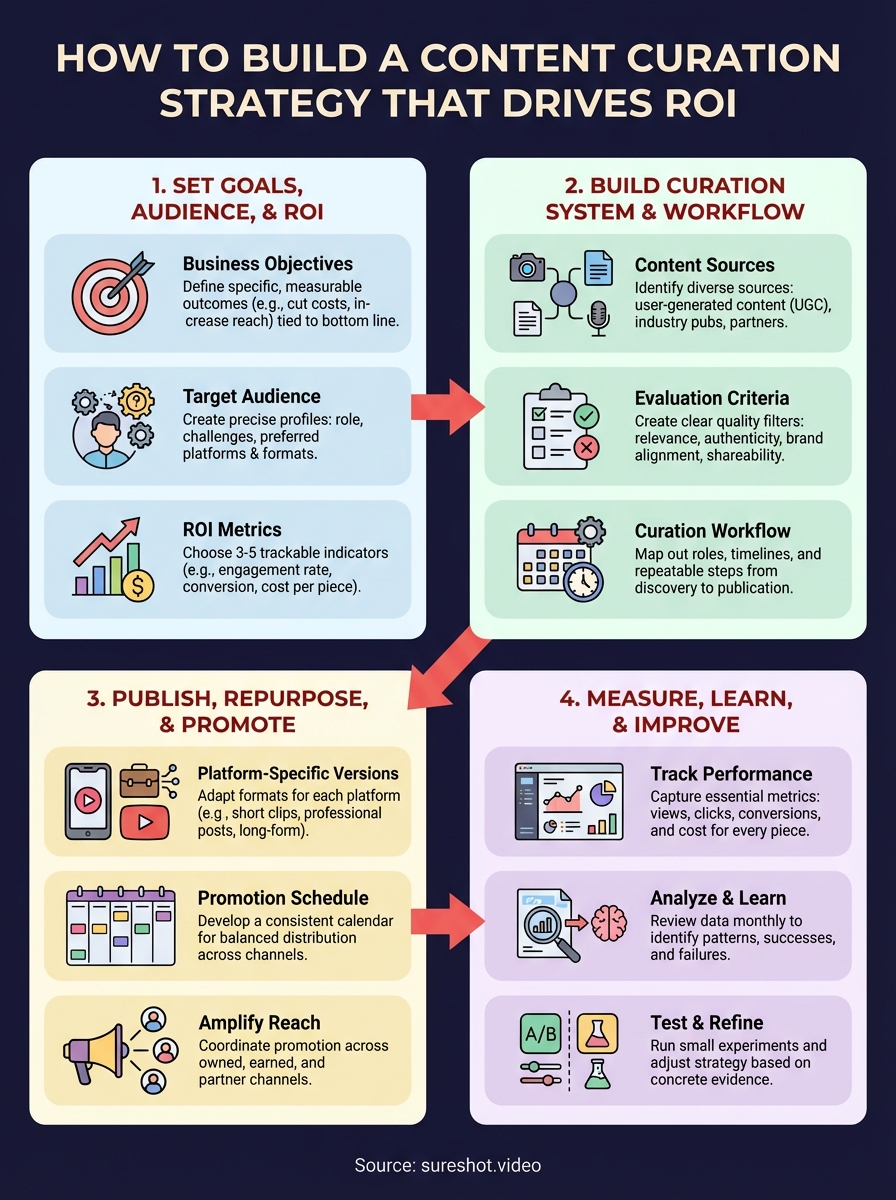
This guide walks you through building a content curation strategy that delivers measurable returns. You'll learn how to set clear goals and metrics, build systems that scale, publish content that converts, and refine your approach based on real data. Each step includes practical actions you can implement immediately, regardless of your team size or budget.
What a content curation strategy actually is
A content curation strategy defines how you collect, organise, and distribute existing content to achieve specific business outcomes. Unlike creating content from scratch, you find valuable material that already exists, add your perspective, and share it with your audience in a way that builds trust and authority. This approach requires systematic processes and clear decision-making frameworks rather than random sharing of whatever catches your eye.
The three core components
Your content curation strategy needs three essential elements working together. First, you need defined sources where you'll consistently find quality content, whether that's user-generated videos from your events, industry publications, or trusted creators. Second, you need evaluation criteria that ensure every piece you share advances your goals and resonates with your audience. Third, you need distribution channels and formats that maximise reach and engagement.

Think of curation like running a gallery. You don't create every piece of art, but you select works that tell a story and arrange them in ways that create meaning. The same principle applies here: your curation choices reveal your expertise and perspective while delivering value your audience can't find elsewhere.
Effective curation transforms scattered content into strategic assets that drive measurable business results.
What curation is not
Curation doesn't mean copying other people's work and calling it yours. You need to add context, analysis, or unique presentation that makes the content more valuable than the original. Simply reposting videos or articles without commentary wastes your audience's time and damages your credibility.
This strategy also isn't about quantity over quality. Sharing everything you find dilutes your message and overwhelms your followers. Instead, you filter relentlessly to share only content that genuinely serves your audience's needs and aligns with your brand values.
Step 1. Set goals, audience, and ROI metrics
Your content curation strategy fails without measurable objectives tied to business outcomes. Start by defining exactly what success looks like for your organization, whether that's reducing production costs, increasing event registrations, or building social media engagement. Write down three specific goals that your curated content must achieve within the next quarter. This clarity prevents you from wasting time on content that looks impressive but delivers no real value.
Define specific business objectives
Business objectives give your curation work direction and purpose. Choose goals that directly impact your bottom line rather than vanity metrics that make reports look good. For event organizers, strong objectives include cutting video production costs by 50%, generating 10,000 social media impressions per event, or driving 200 new email subscribers through curated content campaigns.
Write your objectives using this format: "Achieve [specific metric] by [deadline] through [curation activity]." For example, "Generate 5,000 authentic video views by March 31 through curating and sharing 20 attendee-created event clips." This structure forces you to think in concrete terms rather than vague aspirations.
Identify your target audience
Your audience determines which content deserves curation and which gets ignored. Create a specific profile of who you're serving, including their role, challenges, and content preferences. Event marketers targeting festival attendees need different curated content than those reaching corporate conference planners.

Document these details: age range, professional role, main challenges, platforms they use, and content formats they prefer. If your target audience includes potential attendees aged 25-40 who scroll Instagram during lunch breaks, you'll curate short, visually striking video clips rather than long-form articles. The more precise your audience definition, the faster you can evaluate whether specific content deserves sharing.
Understanding exactly who you serve transforms curation from guesswork into strategic decision-making.
Choose trackable ROI metrics
ROI metrics prove whether your content curation strategy actually works. Select three to five measurable indicators that connect directly to your business goals. Strong metrics include cost per piece of content, engagement rate, click-through rate, conversion rate, and total reach per dollar spent.
Calculate your baseline numbers before launching your curation strategy. If producing original video currently costs $500 per piece and generates 1,000 views, you need those benchmarks to measure improvement accurately. Track your chosen metrics weekly using spreadsheets or analytics platforms, and commit to reviewing performance data every month to spot trends and opportunities.
Step 2. Build your curation system and workflow
Building a scalable content curation strategy requires documented processes and repeatable systems rather than random daily decisions. You need structured workflows that let your team evaluate, organise, and prepare content quickly without compromising quality. This systematic approach cuts the time you spend hunting for content by 70% while ensuring consistent output that matches your brand standards.
Choose your content sources
Your content sources determine the quality and authenticity of everything you share. For event organizers, user-generated videos from attendees provide the most valuable material because they capture genuine moments and perspectives that professional crews miss. Set up systems that make content submission effortless, such as mobile apps where attendees upload clips using a simple event PIN.
Diversify beyond attendee content to maintain a steady content pipeline. Industry publications, keynote speaker presentations, venue partners, and sponsor collaborations all offer valuable material for curation. Create a master list of your approved sources, organised by category and reliability rating. Update this list monthly as you discover new sources and eliminate ones that stop delivering quality content.
Track where your highest-performing curated content originates. If attendee-submitted videos consistently generate five times more engagement than other sources, adjust your collection efforts accordingly. This data-driven approach ensures you focus resources on sources that deliver measurable returns.
Create evaluation criteria
Every piece of content you consider needs to pass through clear quality filters before earning a spot in your curation strategy. Build a simple scoring system that evaluates content against your specific goals and audience needs. Strong evaluation criteria include video quality, authenticity, brand alignment, emotional impact, and shareability potential.
Use this content evaluation template for consistent decision-making:
Content Piece: [Title/Description]
Source: [Where it came from]
Relevance Score (1-5): [How well it matches audience interests]
Quality Score (1-5): [Technical quality and polish]
Brand Fit (1-5): [Alignment with your values and message]
Engagement Potential (1-5): [Likelihood of shares and comments]
Total Score: [Out of 20]

Decision: Accept / Reject / Request edits
Notes: [Specific observations]
Content scoring below 12 points gets rejected immediately, while pieces scoring 16 or higher move directly to your publishing queue. This removes subjective debates and speeds up your curation workflow significantly.
Systematic evaluation transforms content curation from opinion-based guesswork into objective decision-making.
Build the curation workflow
Map out each step from content discovery to final publication. Your workflow needs defined roles, clear handoffs, and documented timelines that prevent bottlenecks. Start by assigning specific team members to each workflow stage, whether that's sourcing, evaluation, editing, or scheduling.

Create a weekly curation schedule using this structure:
- Monday: Review all new submissions and source materials
- Tuesday: Evaluate content using your scoring template
- Wednesday: Edit and prepare approved pieces for publication
- Thursday: Schedule content across your distribution channels
- Friday: Analyse performance data and refine your approach
Document your workflow in a shared tool that your entire team can access. Include response time targets for each stage, such as evaluating submissions within 48 hours or completing edits within 24 hours. These concrete deadlines prevent content from sitting idle while keeping your pipeline moving efficiently.
Step 3. Publish, repurpose, and promote curated content
Publishing curated content requires strategic adaptation for each platform and audience segment you serve. A single attendee video from your event can become Instagram Stories, LinkedIn posts, email newsletter highlights, and website testimonials when you repurpose it correctly. This multiplication approach gets maximum value from every piece of content you curate while reducing the effort needed to maintain consistent visibility across channels.
Create platform-specific versions
Each platform demands different formats and optimization approaches for curated content to perform well. Transform a 60-second attendee video into a 15-second Instagram Reel with captions, a 30-second LinkedIn post with professional context, and a full-length YouTube upload with searchable descriptions. The core content stays the same, but your presentation changes to match platform specifications and user expectations.
Use this repurposing template for every curated video:
Original Content: [Event clip description]
Instagram: 15s vertical, captions, trending audio, 3-5 hashtags
Facebook: 30s horizontal, native upload, question in caption
LinkedIn: 45s square, professional context, tag speakers/sponsors
YouTube: Full length, SEO title, detailed description, timestamps
Email: Embedded 20s clip, compelling subject line, CTA button
Add platform-specific elements that increase engagement rates significantly. Instagram content needs bright opening frames and text overlays, while LinkedIn posts require professional framing and industry context. Test different versions to discover which adaptations generate the strongest response from your specific audience.
Strategic repurposing transforms one curated piece into ten distinct assets across your marketing channels.
Build a promotion schedule
Your content curation strategy fails if you publish randomly without coordination or timing strategy. Create a weekly publishing calendar that balances curated content across all your active channels while maintaining consistent audience touchpoints. Schedule Instagram posts for weekday lunch hours when engagement peaks, LinkedIn updates for Tuesday through Thursday mornings, and email sends for Wednesday afternoons based on your specific audience behavior data.

Batch your promotion work to save time and maintain consistency. Dedicate Thursday afternoons to scheduling all curated content for the following week using native platform tools or automation software. This approach prevents daily scrambling and ensures your content curation strategy delivers predictable visibility that builds audience expectations and loyalty.
Amplify through multiple channels
Maximise reach by coordinating promotion across owned, earned, and partner channels simultaneously. Share curated attendee videos through your brand accounts, encourage the original creators to reshare with their networks, and ask sponsors or partners to amplify content that features their participation or products. This coordinated approach multiplies your organic reach without additional content investment.
Step 4. Measure, learn, and improve over time
Your content curation strategy needs continuous measurement and refinement to deliver increasing returns over time. Set up tracking systems that capture performance data automatically, then review that data monthly to identify patterns and opportunities. This disciplined approach reveals which curated content drives real business results and which wastes your resources, allowing you to double down on what works and eliminate what doesn't.
Track your performance metrics
Build a simple tracking spreadsheet that records essential metrics for every piece of curated content you publish. Capture the content source, publication date, platform, engagement numbers, click-through rates, and conversion data in one centralized location. Update this tracker weekly so you can spot trends quickly and make informed decisions about your curation efforts.
Use this performance tracking template:
Content ID | Source | Platform | Publish Date | Views | Engagement Rate | Clicks | Conversions | Cost | ROI
001 | Attendee UGC | Instagram | 2025-01-15 | 5,200 | 8.3% | 430 | 12 | $25 | 280%
002 | Attendee UGC | LinkedIn | 2025-01-16 | 2,100 | 4.1% | 86 | 3 | $25 | 140%
Calculate your cost per engagement and return on investment for each content piece to understand true performance beyond vanity metrics.
Analyse what works and what fails
Review your tracking data monthly to identify clear performance patterns across content types, sources, and platforms. Sort your spreadsheet by engagement rate and ROI to reveal your top performers, then analyse what makes them successful. You might discover that vertical videos from attendees consistently outperform horizontal ones by 300%, or that content featuring recognizable speakers drives twice as many conversions as general crowd footage.
Document your findings in a simple insights log that informs future curation decisions. Failed content teaches you just as much as successful pieces when you examine why it underperformed.
Data-driven analysis transforms your content curation strategy from guesswork into a predictable growth system.
Test and refine your approach
Run small experiments that test specific assumptions about what your audience wants from curated content. Try publishing the same attendee video at different times, with different captions, or on different platforms to discover optimal conditions for maximum engagement. Limit each test to one variable so you can identify exactly what drives performance changes.
Implement your learnings immediately rather than waiting for perfect data. Adjust your evaluation criteria, source priorities, or publishing schedule based on concrete evidence from your tracking spreadsheet, and your content curation strategy will deliver stronger results every quarter.
Bring your strategy to life
Your content curation strategy transforms from planning to profit when you implement the right systems and tools. Start by executing one step from this guide today rather than waiting for perfect conditions. Set your goals and metrics this week, build your workflow document next week, and begin curating your first batch of content within the month. This incremental approach delivers faster results than attempting to launch everything simultaneously while building team confidence through early wins.
Event organizers gain the biggest advantage by tapping into attendee-created content that already exists at every gathering. SureShot lets you collect authentic video moments from your events systematically, giving you a constant stream of curated content that costs a fraction of professional production while maintaining quality. Book a demo to see how automated collection and AI-powered curation can reduce your content costs by 80% while multiplying your promotional reach across every channel.