
Event organisers spend thousands on professional videographers, only to end up with a single highlight reel that gets posted once and forgotten. Meanwhile, attendees are already filming, already sharing, already creating content that's more authentic than anything a camera crew could produce. The trick isn't making more polished content. It's making it ridiculously easy for people to share clips from the moments they're actually experiencing.
Why People Actually Share Clips
Nobody shares because you asked nicely. They share because something made them feel something, or because sharing makes them look good.
When someone captures a moment at your event, they're not thinking about your brand. They're thinking about how this makes them look to their mates. That festival stage. That product launch. That speaker who said the thing everyone's been thinking.
The psychology is simple:
- Sharing proves they were there
- It signals their taste and interests
- It connects them with others who care about the same things
- It gives them social currency
Your job is to make it so easy to share clips that the friction disappears. If they have to download footage, edit it, export it, then upload it somewhere else, they won't. They'll just move on.
The Authenticity Problem
Polished content has its place. But when you're trying to spread something organically, perfection kills reach.
People scroll past ads. They stop for their friend's shaky footage of something genuine. The algorithm knows this. Platforms like TikTok and Instagram actively push content that feels raw and real over stuff that looks like it came from a marketing department.
User-generated content platforms work because they tap into this. Instead of one sanitised video, you get dozens of perspectives. Different angles. Different moments. Different voices.
How to Actually Get People to Share Clips
Stop asking people to "tag you" or "use our hashtag." That's not a strategy. That's hoping.
Here's what works:
- Make capture dead simple - If they need to leave the moment to figure out your app, you've already lost
- Provide instant value - Show them their clip immediately, polished enough to share
- Remove technical barriers - No uploads, no exports, no "processing"
- Give them ownership - It's their content, not yours
The best event content comes from people who were there, not people you paid to be there. Your attendees have friends who trust them. You don't have that.
Technical Reality Check
Most platforms make you choose between easy and good. You can have a simple sharing flow or you can have quality control, but rarely both.
| Approach | Pros | Cons |
|---|---|---|
| Professional crew only | Consistent quality, full control | Expensive, limited perspectives, feels promotional |
| Open free-for-all | Maximum coverage, authentic | No curation, variable quality, rights nightmare |
| Curated user-generated | Authentic + quality, scalable | Requires platform, needs moderation workflow |
The third option is where things get interesting. You let people capture what matters to them, but you curate the content before it represents your event.
Building a System That Works
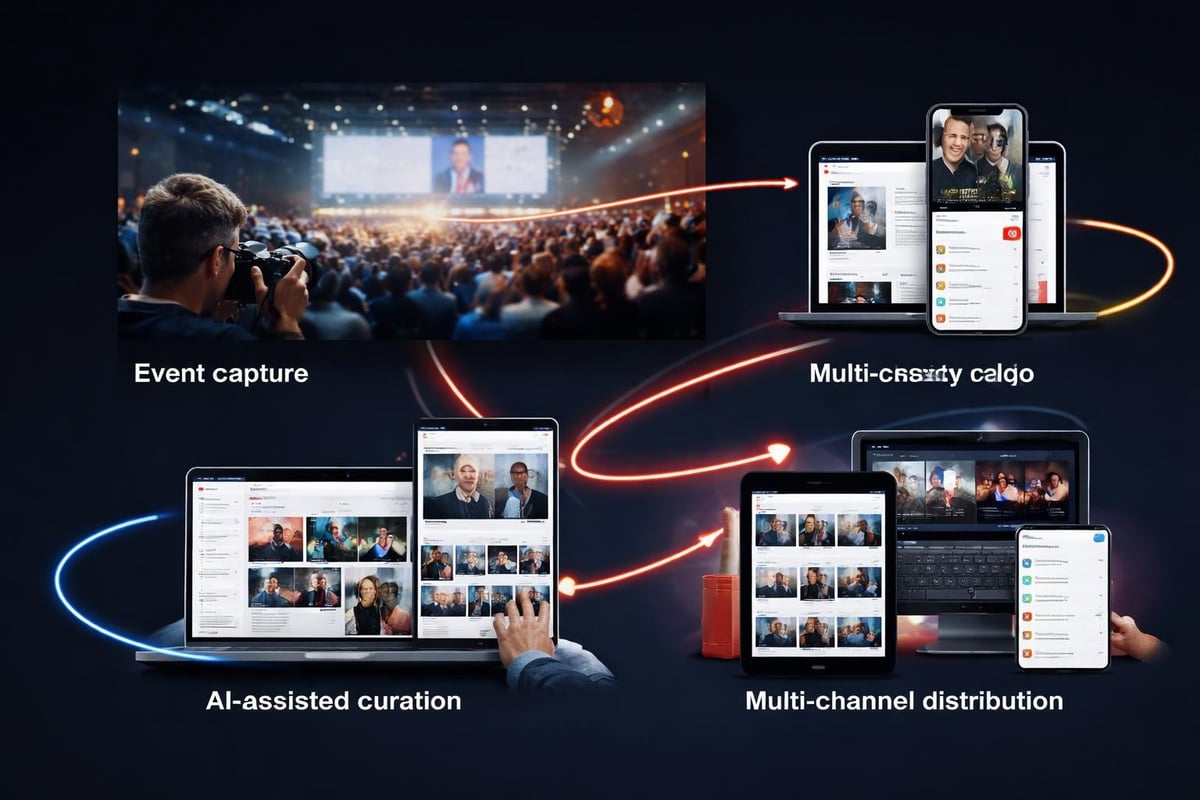
You need three things: a way for people to submit clips, a way to review them quickly, and a way to distribute what's good.
The submission part is easy. People already have phones. They already know how to record video. You just need to give them a reason to send it to you instead of just posting it themselves.
The curation part is harder. You can't watch 200 clips manually and decide which ones to share. This is where AI actually helps, not by generating fake content, but by sorting real content based on quality signals: stable footage, clear audio, good framing.
Distribution happens in two layers:
- Attendees share their own clips to their networks (organic spread)
- You share the best clips to your official channels (amplified reach)
When both happen simultaneously, you get compound growth. Their audience sees it. Your audience sees it. The overlap discovers your event through multiple touchpoints.
What Makes a Clip Worth Sharing
Length matters. Attention spans are short, but that doesn't mean every clip needs to be six seconds.
The right length is: as long as it takes to convey one complete moment. A reaction shot? Three seconds. A product demo? Maybe twenty. A performance highlight? Could be forty-five.
Elements that increase shares:
- Clear focal point (viewers know what they're watching within one second)
- Emotional peak (surprise, excitement, recognition)
- Social proof (crowds, reactions, energy)
- Relatability (people see themselves in the situation)
Bad clips try to show everything. Good clips show one thing well. Short-form video platforms have trained everyone to expect this. Work with it, not against it.
Rights and Permissions Without the Headache
Here's where most event organisers panic. "What if someone films something they shouldn't? What if we share a clip and don't have rights?"
First, terms of service. Make it clear that by submitting, attendees grant you permission to use their content. Don't hide this in paragraph seventeen. Put it upfront.
Second, consent management during capture. If someone's recording at your event through your platform, they're already agreeing to specific terms. Build that into the flow.
Third, moderation before publication. You're not sharing everything. You're sharing what's good and what's safe. That review step protects you.
None of this requires a legal team. It requires clear communication and a system that doesn't publish anything without a human (or smart AI) checking it first.
The Distribution Strategy
You've got clips. Now what?
Don't just dump them on Instagram and call it a day. Different platforms want different things.
| Platform | Ideal Clip Length | Format Priority | Best For |
|---|---|---|---|
| TikTok | 15-60 seconds | Vertical, 9:16 | Discovery, viral potential |
| Instagram Reels | 15-90 seconds | Vertical, 9:16 | Existing followers, aesthetic moments |
| YouTube Shorts | 15-60 seconds | Vertical, 9:16 | Search, evergreen content |
| 30-90 seconds | Square or horizontal | Professional events, B2B | |
| 15-45 seconds | Any | News, reactions, timely content |
Tools for video collaboration let teams review and approve clips together, but the real work is choosing what goes where. A clip that crushes on TikTok might die on LinkedIn.
The Economics of User-Generated Clips
Professional event videography costs anywhere from £2,000 to £20,000 depending on scale. You get one angle, one perspective, one final cut.
User-generated clips cost you a platform subscription and moderation time. You get dozens of angles, authentic reactions, and content that people actually want to share.
Cost breakdown comparison:
- Traditional: High upfront cost, single use, limited shelf life
- User-generated: Low fixed cost, multiple uses, ongoing value
The clips don't stop being useful after the event ends. They become content curation resources for future marketing, testimonials, and social proof.
Real Reach vs Vanity Metrics
A professional highlight reel might get 5,000 views on your YouTube channel. Impressive, until you realize those are people who already follow you.
Twenty attendees each sharing clips to their networks of 500 people reaches 10,000 people who've never heard of your event. Different audience. Better conversion potential.
The multiplier effect is real. When you share clips from attendees, and those attendees share the same clips, and their friends see both versions, you're not just reaching more people. You're reaching them through trusted sources.
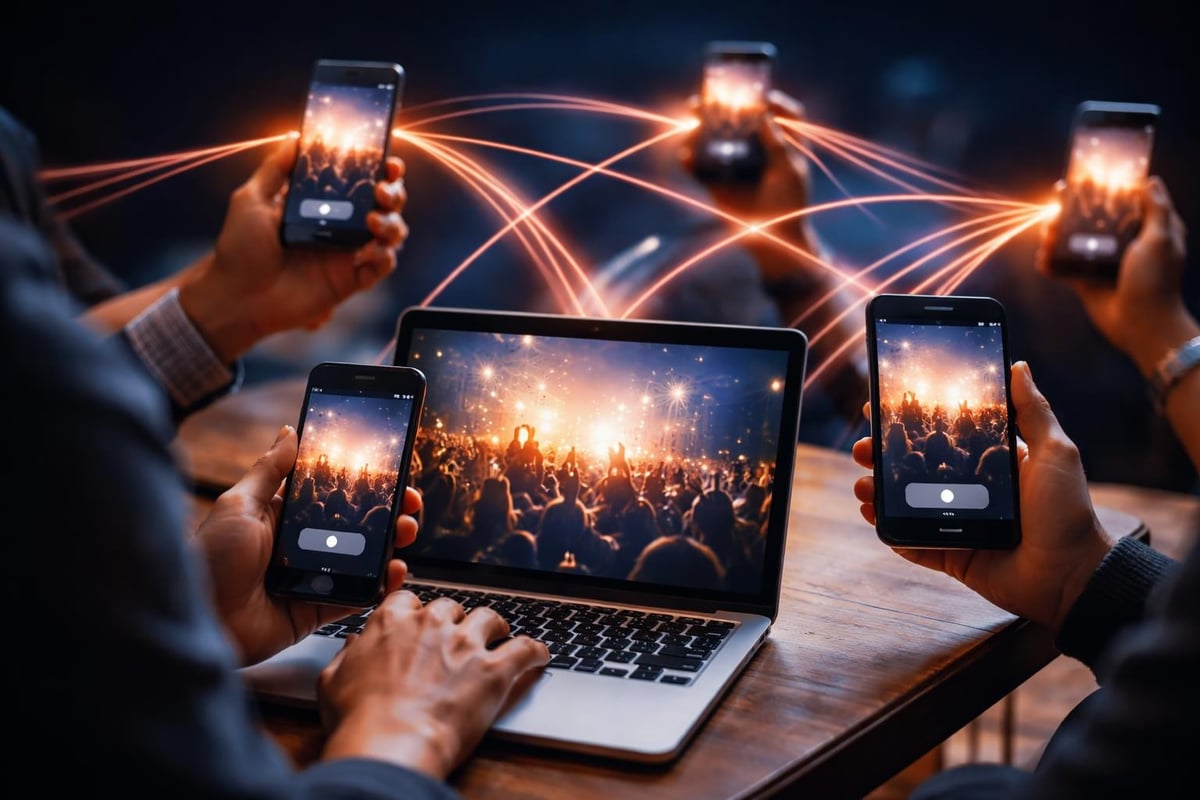
Making It Seamless for Attendees
The best system is invisible. People show up, capture what matters to them, and share clips without thinking about the technical bits.
What kills adoption:
- Complicated apps with seventeen features
- Mandatory account creation before they can record anything
- Uploads that take forever on event WiFi
- No immediate preview of what they captured
What drives adoption:
- One-tap recording that just works
- Instant playback with basic polish already applied
- Easy sharing to their own socials
- Option to submit to the event organiser simultaneously
Collaborative video editing tools solve part of this, but they're built for teams producing content together, not crowds capturing moments individually. You need something designed specifically for crowdsourced event video.
Curation Without Bottlenecks
Manual review doesn't scale. You can watch fifty clips. You can't watch five hundred.
AI helps here, not by making decisions, but by surfacing what's worth looking at. Technical quality filters catch shaky footage, poor lighting, unclear audio. Duplicate detection prevents the same moment from clogging your queue.
Curation workflow that works:
- Automated quality filtering (removes obviously unusable clips)
- AI-assisted sorting (highlights potential great moments)
- Human review (final yes/no on what represents your event)
- Batch approval (approve multiple clips in one session)
You're not trying to find the perfect clip. You're trying to quickly identify which clips are good enough to share. Different goal, different process.
Content Rights and Usage
When someone submits a clip, they're giving you something valuable. Respect that.
Be transparent about how you'll use it. Event recap video? Cool. Advertising campaign six months later? Maybe ask first.
Content licensing doesn't have to be complicated. Simple terms: you can share it, you'll credit them, you won't sell their clip to third parties. Most people are fine with that.
The attendees who create the best content often become your best advocates. Treat them well and they'll keep creating for you.
Platform Features That Actually Matter
Forget fancy transitions and seventeen filter options. Here's what makes people actually use a platform to share clips:
- Speed - From capture to shareable in under ten seconds
- Quality - Automatic stabilization and basic colour correction
- Flexibility - Works with whatever phone they brought
- Privacy - Control over who sees what before it's public
Everything else is decoration. If your platform can't nail these four, the rest doesn't matter.
Event video platforms either make this easy or they don't. There's not much middle ground. People won't wrestle with software during an event. They'll just use their normal camera app and you'll get nothing.
Measuring What Matters
Views are nice. Shares are better. Shares with genuine engagement are what you're after.
Metrics worth tracking:
- Clip submission rate (percentage of attendees who contributed)
- Share-through rate (clips shared vs clips submitted)
- Secondary shares (people sharing clips they didn't create)
- Conversion from shared clips (traffic, registrations, sales)
The last one is tricky but crucial. If you're getting tons of shares but zero business impact, you're collecting vanity metrics.
| Metric Type | Easy to Track | Actually Useful |
|---|---|---|
| Total views | Yes | Sometimes |
| Share count | Yes | Usually |
| Engagement rate | Moderate | Yes |
| Attribution to conversion | Hard | Extremely |
Most platforms stop at views. The ones that track the full journey from share to conversion are worth the investment.
The Long Game
Share clips aren't just event marketing. They're proof that your event created moments worth capturing.
Six months later, when you're promoting the next edition, you're not selling an abstract promise. You're showing exactly what happened last time, through the eyes of people who were there.
That's infinitely more convincing than any promotional video you could produce. It's also infinitely cheaper to create, because your attendees already did the work.
The content library you build from fan video submissions becomes an asset that compounds. Each event adds to it. Each clip increases the social proof. Each share reaches people who might attend next time.
This isn't a tactic. It's infrastructure for sustainable event growth.
Event attendees are already creating content. The question is whether you're making it easy for them to share clips that benefit both of you. When the system works, everyone wins: they get shareable moments, you get authentic marketing, and future attendees see proof that your event delivers. SureShot ApS builds exactly this, turning your attendees into storytellers whose content spreads naturally while cutting your production costs to basically nothing.