

Content Curation Best Practices: Strategy, Steps & Tools
You need to publish content consistently, but creating everything from scratch drains your time and energy. Your audience expects regular updates, but between managing events and daily operations, content creation often falls to the bottom of your priority list. The pressure to maintain an active online presence while juggling everything else can feel overwhelming.
Content curation offers a practical solution. Instead of creating every piece from scratch, you can share valuable content from trusted sources and add your own insights. This approach keeps your audience engaged, positions you as a trusted resource, and saves hours of work each week.
This guide walks you through the essentials of content curation. You'll learn how to build a strategy that aligns with your goals, find and evaluate quality sources, add meaningful context to curated content, and use tools that make the process efficient. By the end, you'll have a repeatable system for curating content that resonates with your audience and supports your business objectives.
What content curation is and how it works
Content curation involves finding, selecting, and sharing valuable content from external sources with your audience. You act as a filter, sifting through the massive volume of available content to identify pieces that align with your audience's interests and needs. Unlike content creation, where you build everything from scratch, curation lets you leverage existing high-quality material and add your own perspective or commentary to make it relevant for your specific audience.
This approach differs from content aggregation in one critical way. Aggregation uses automated tools and algorithms to collect content based on keywords or topics, often with little human oversight. Curation requires manual selection and evaluation, where you personally assess each piece for quality, relevance, and trustworthiness before sharing it. Your judgment and expertise become the value you add to the content discovery process.
Content curation best practices centre on adding meaningful context rather than simply reposting links.
The curation workflow
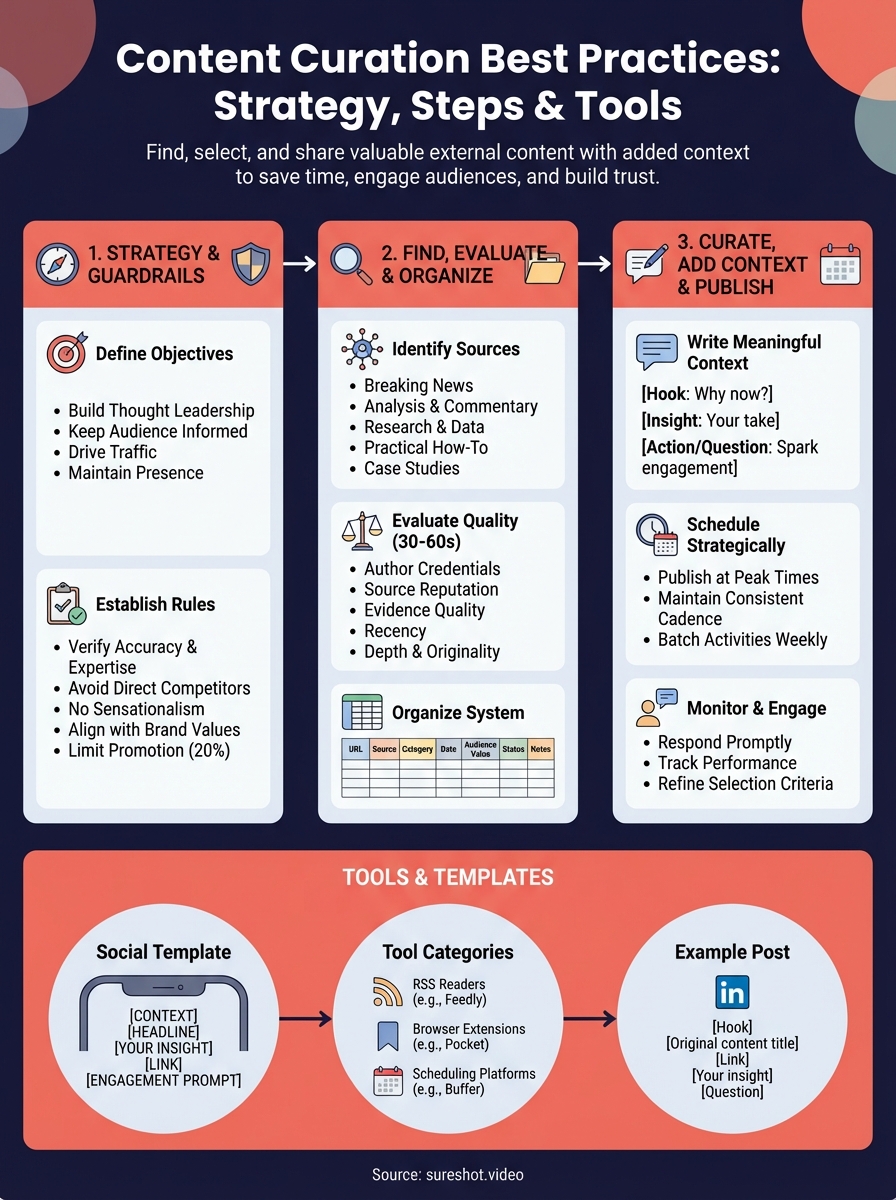
The basic process follows three core phases that you'll repeat regularly. First, you discover content by monitoring trusted sources like industry publications, expert blogs, newsletters, and social media feeds. Second, you evaluate each piece against your quality standards and audience needs, asking whether it provides genuine value or solves a specific problem. Third, you present the content to your audience with your own insights, observations, or questions that spark conversation.

Your role as curator means you're not just sharing links. You're filtering signal from noise, helping your audience save time by directing them to content worth their attention. This positions you as a valuable resource who understands both the content landscape and your audience's specific needs.
Step 1. Set strategy, goals, and guardrails
Your curation efforts need clear direction and boundaries before you start collecting content. Without a defined strategy, you'll waste time sharing irrelevant material that doesn't serve your audience or business. This first step establishes the foundation for all your curation decisions, ensuring every piece you share contributes to specific objectives and maintains consistent quality standards.
Define your curation objectives
Start by identifying what you want to achieve through content curation. Your goals might include building thought leadership in your industry, keeping your audience informed about trends, driving traffic to your website, or maintaining consistent social media activity between original posts. Each objective requires different content selection criteria and sharing frequencies.
Write down 2-3 specific goals that align with your broader business strategy. For example, if you organise music festivals, your goals might be: showcase emerging artists and trends to position yourself as an industry insider, maintain daily social media presence to keep your brand visible between events, and drive newsletter subscriptions by curating exclusive industry insights. These concrete targets help you evaluate whether potential content deserves sharing.
The most effective content curation best practices start with measurable goals that tie directly to business outcomes.
Establish content guardrails
Create firm rules that govern what you will and won't share. These guardrails protect your reputation and ensure consistency across all curated content. Your rules should address content quality, source credibility, topic relevance, and alignment with your brand values.
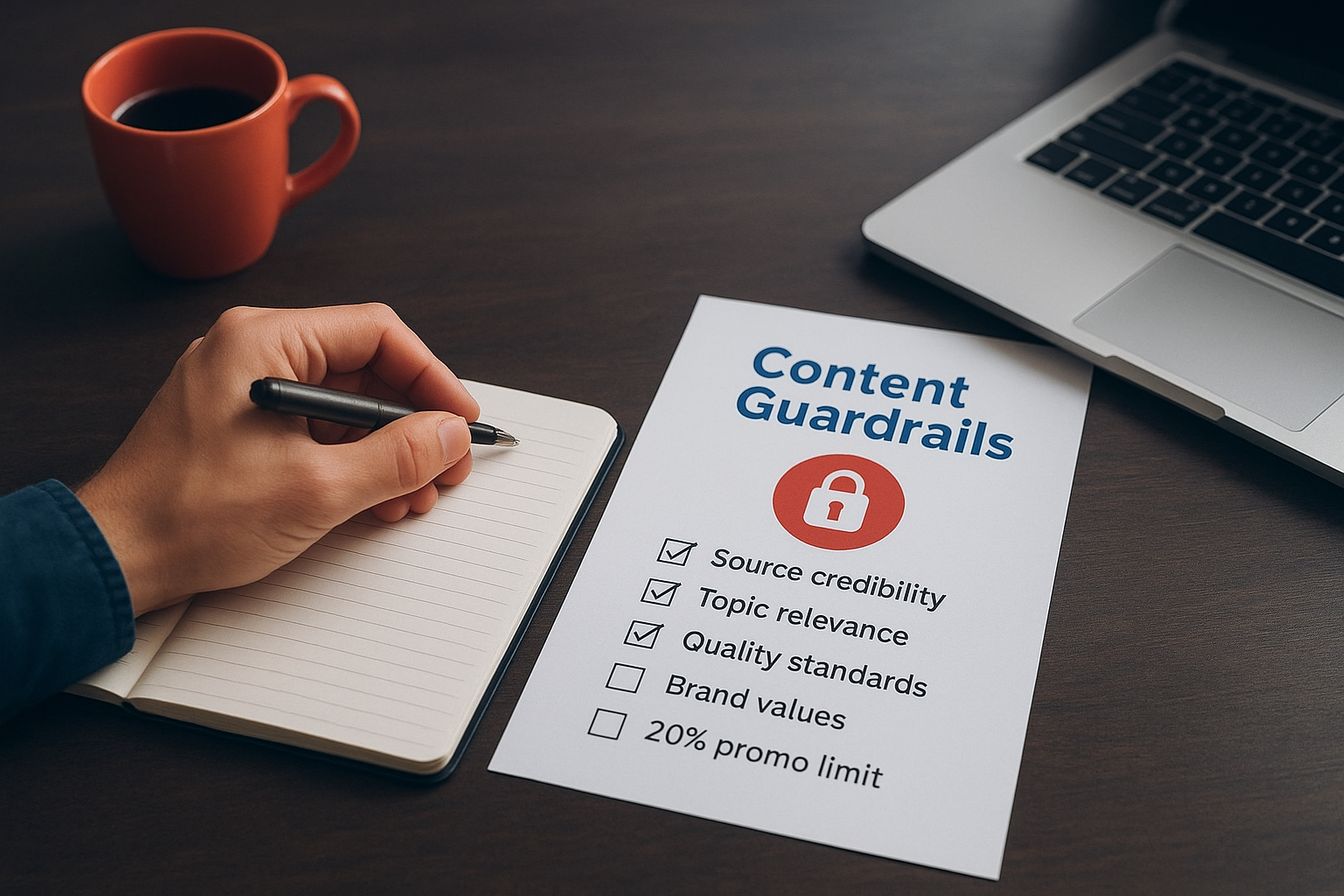
Consider implementing guidelines like these for your curation process:
- Only share content from sources you've personally verified for accuracy and expertise
- Avoid sharing content from direct competitors unless it provides exceptional value your audience needs
- Skip sensationalized headlines or clickbait regardless of topic relevance
- Never share content that contradicts your stated values or positions
- Limit promotional content to 20% of total curated material
- Verify all statistics and claims before sharing research or data-heavy content
Document these non-negotiable standards in a simple reference guide you can consult during content selection. This prevents quality drift over time and helps team members make consistent curation decisions when multiple people handle your content workflow.
Step 2. Find, evaluate, and organise sources
Your content curation success depends on consistently accessing quality sources and having a system to evaluate what's worth sharing. This step transforms random content discovery into a repeatable process that feeds your curation workflow with material your audience actually values. You'll build a reliable network of sources, establish evaluation criteria to separate signal from noise, and create an organizational system that makes content selection efficient.
Identify reliable content sources
Start by listing 10-15 sources you already trust in your industry. These might include established trade publications, respected thought leaders, industry associations, or companies known for releasing valuable research. For event organizers, sources might include festival industry newsletters, venue management blogs, ticketing platform insights, or audio equipment manufacturers publishing technical guides.
Expand your source list by investigating where your audience already consumes content. Ask customers directly what publications they read, which experts they follow, or what newsletters land in their inbox. Check the reference lists and citations in articles you find valuable to discover new sources. Follow the people your target audience engages with on professional networks like LinkedIn.
Organise your sources into these categories:
- Breaking news sources: Publications that report industry developments first
- Analysis and commentary: Experts who interpret trends and provide perspective
- Research and data: Organizations publishing original studies and statistics
- Practical how-to content: Sources explaining tactics and providing templates
- Case studies and stories: Publications featuring real examples and results
Evaluate content for quality and fit
Create a simple scoring system to assess each piece of content before sharing. Your evaluation should examine both the content's inherent quality and its relevance to your specific audience. This prevents you from sharing material that looks good at first glance but doesn't serve your curation goals.
Check these quality indicators before adding content to your queue:
- Author credentials: Does the writer demonstrate genuine expertise through credentials, experience, or portfolio?
- Source reputation: Has the publication established credibility over time with accurate reporting?
- Evidence quality: Does the piece cite specific examples, data, or research rather than making unsupported claims?
- Recency: Is the information current, or has the landscape changed since publication?
- Depth: Does the content provide substantial insights beyond surface-level observations?
- Originality: Does it add new perspectives rather than rehashing common knowledge?
Following content curation best practices means rejecting material that fails your quality standards, even when it covers relevant topics.
Your evaluation process should take 30-60 seconds per piece. If content passes your initial screening, read it completely before deciding to share. Skim reading often misses context that changes whether content deserves your endorsement.
Build your content organization system
Design a simple tracking system that captures potential content without creating administrative burden. Your system needs to record the content URL, source, topic category, publication date, and your initial assessment of why it matters to your audience.
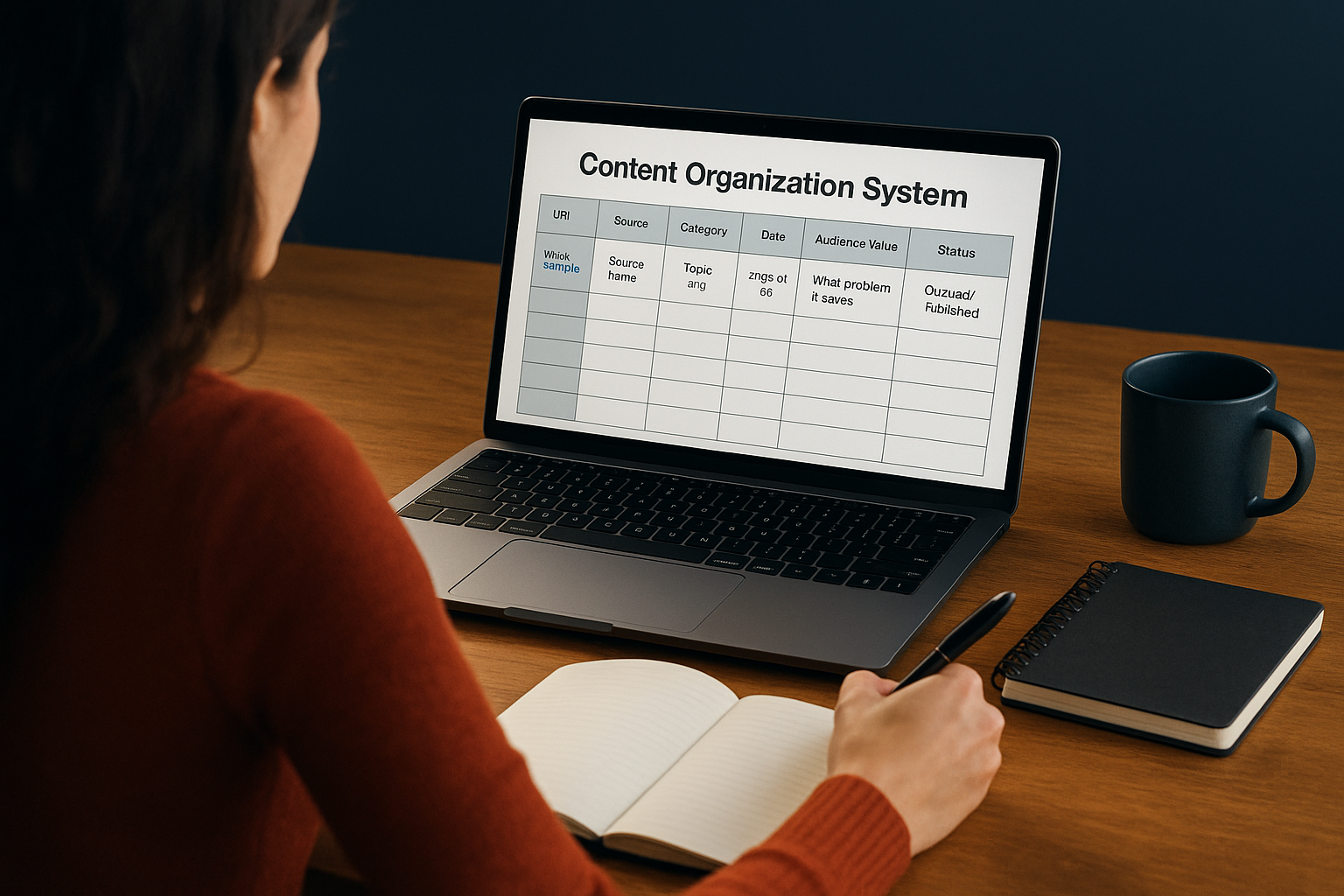
Create a spreadsheet with these columns for tracking curated content:
| URL | Source | Category | Date | Audience Value | Status | Notes |
|---|---|---|---|---|---|---|
| [link] | Source name | Topic tag | 2026-01-06 | What problem it solves | Queued/Published | Your commentary angle |
Set aside 15-20 minutes daily for source monitoring and content evaluation. Batch this activity at a consistent time rather than constantly interrupting your workflow to check sources. Add promising content directly to your tracking system with notes about why it resonated, so you remember your thinking when you return to publish it.
Step 3. Curate, add context, and publish
Your selected content becomes valuable only when you add your unique perspective and distribute it effectively. This step transforms curated material from simple link sharing into strategic content that positions you as a knowledgeable resource while serving your audience's specific needs. You'll learn how to craft meaningful commentary, time your publications for maximum impact, and maintain engagement after content goes live.
Write meaningful context for curated content
Add your personal insights or observations to every curated piece you share. Your commentary explains why the content matters, how it connects to current events in your industry, or what specific takeaway your audience should notice. This context distinguishes thoughtful curation from automated link dumping and demonstrates your expertise.

Structure your commentary using this three-part framework:
- Hook: One sentence explaining why you're sharing this content now
- Key insight: Your personal take on the most important point or how it applies to your audience
- Action or question: What you want readers to do or think about after consuming the content
Here's a template you can adapt for different platforms:
[Hook that connects to current situation]

[Original content title/headline]
[Link]

[Your insight or interpretation in 2-3 sentences]

[Question to spark discussion or specific action to take]
For example: "Event security protocols are changing fast after recent industry incidents. This guide from [source] breaks down the new vendor requirements most venues will implement this quarter. Pay special attention to the section on digital credential systems, as these will likely become standard by summer. What security updates are you planning for your next event?"
Your commentary should never just summarize the original content. Readers can do that themselves by clicking through. Instead, highlight the specific element that caught your attention, explain how it connects to broader trends, or offer a contrasting viewpoint that adds dimension to the discussion.
Effective content curation best practices require you to contribute meaningful perspective rather than simply amplifying others' work.
Schedule and publish strategically
Plan your publication timing based on when your audience actively engages with content. Review your analytics to identify peak engagement windows, then schedule curated content to publish during these periods. Most social platforms show higher engagement during specific weekday hours, typically mid-morning and early evening.
Maintain a consistent publishing cadence that keeps your brand visible without overwhelming followers. A sustainable ratio might allocate 60-70% of your content to original material and 30-40% to curated pieces. This balance lets you maintain regular posting while reducing content creation pressure.
Batch your publishing activities rather than sharing content immediately upon discovery. Set aside a weekly block to review your tracked content, write commentary for selected pieces, and queue everything for the upcoming week. This batching approach prevents reactive posting and ensures each curated piece receives proper context and timing consideration.
Monitor and engage with responses
Check back on published curated content regularly to respond to comments, questions, or discussions that emerge. Your engagement transforms passive content sharing into active conversation that builds community and demonstrates your commitment to dialogue. Respond within 24 hours to maintain momentum and show your audience their input matters.
Track which curated content generates the strongest response to refine your selection criteria over time. Note patterns in topics, formats, or sources that consistently drive engagement, then prioritise similar content in future curation. This feedback loop helps you sharpen your understanding of what truly resonates with your specific audience rather than what general best practices suggest should work.
Examples, templates, and tool ideas
Real examples, ready-to-use templates, and practical tool suggestions help you implement content curation immediately rather than getting stuck in planning mode. This section provides specific formats you can adapt for different platforms, a flexible template structure for your curation posts, and categories of tools that streamline your workflow without overwhelming you with options.
Example curation posts by platform
Your curation format changes based on where you publish and how that platform's audience expects to consume content. Social media posts require brevity and visual appeal, while newsletters allow deeper analysis and multiple curated pieces in one message.
Here's a LinkedIn curation post example:
Festival attendance hit record highs in 2025 despite economic concerns.

New research from [Industry Association] shows 73% of attendees
prioritise experiences over material purchases, explaining the surge.

The data on multi-day pass sales (page 8) contradicts conventional
wisdom about budget constraints. Worth reviewing before you finalize
2026 pricing strategies.

Link: [URL]

How are you seeing this trend play out in your ticket sales?
This format works because it opens with the main finding, adds your specific insight about what matters in the data, and closes with a question that invites discussion. You can adapt this structure by changing the opening statement to match whatever content you're sharing.
Template for social media curation
Use this five-part template to structure your social curation posts consistently:
[CONTEXT: Why this matters now in 1 sentence]

[HEADLINE/TITLE from original source]

[YOUR INSIGHT: What you noticed that others might miss,
or how this applies to your audience specifically - 2-3 sentences]

[LINK to original content]

[ENGAGEMENT PROMPT: Question or action step]
The template ensures you never forget to add your perspective before sharing. Fill in each bracket section for every curated piece, adjusting the length based on platform character limits. Twitter/X posts might compress the insight section to one sentence, while LinkedIn allows fuller commentary.
Applying content curation best practices consistently becomes easier when you follow a template that builds your perspective into every share.
Tool categories to streamline workflow
Focus on three tool types that address specific friction points in the curation process. RSS readers like Feedly let you monitor multiple sources from one dashboard instead of visiting dozens of websites daily. Browser extensions such as Pocket or Instapaper save articles for later review when you're in evaluation mode rather than discovery mode. Scheduling platforms like Buffer or Hootsuite let you batch your publishing and maintain consistent output without logging into multiple networks throughout the day.
Select one tool from each category to start, avoiding the trap of collecting too many tools that create their own management burden. Your goal is reducing friction, not adding complexity to your workflow.
Moving forward with content curation
Start implementing these content curation best practices this week rather than waiting for the perfect system. Pick three trusted sources from your industry, set aside 20 minutes daily for content review, and publish your first curated piece with personal commentary tomorrow. Your curation skills improve through practice, not planning.
Track which curated content drives the strongest engagement over the next month. This data reveals what your audience truly values and helps you refine your source selection and commentary style. Adjust your approach based on real feedback rather than assumptions about what should work.
Consider how user-generated content from your event attendees creates another valuable curation opportunity. These authentic moments captured by participants offer perspectives professional content can't match. SureShot helps you collect and organise attendee video content efficiently, turning your events into ongoing content sources. Book a demo to see how the platform streamlines video collection and curation for event organizers.