
Event Marketing Plan Outline: Step-By-Step Framework In 2026
You've secured the venue, lined up speakers or performers, and locked in a date. Now comes the part that determines whether seats fill or stay empty: marketing. Without a solid event marketing plan outline, even the most exciting events can fall flat because nobody knew they were happening. The difference between a packed house and disappointing turnout often comes down to how well you structure your promotional strategy before launch day.
Most event organizers know they need to promote their event. Fewer have a documented plan that maps out every channel, timeline, and content piece required to make it happen. This gap leads to last-minute scrambles, inconsistent messaging, and missed opportunities to capture authentic moments that could fuel future campaigns. At SureShot, we've seen firsthand how event content, especially video from attendees themselves, becomes one of the most powerful marketing assets available. But capturing and using that content effectively requires planning from the start.
This guide walks you through a complete framework for building your event marketing plan in 2026. You'll find step-by-step instructions for each phase, from setting objectives to post-event follow-up, along with practical tips for integrating user-generated content into your strategy. Whether you're organising a music festival, corporate conference, or community gathering, this outline gives you the structure to promote with confidence.
What to decide before you outline the plan
Before you draft your event marketing plan outline, you need to make three foundational decisions that shape everything else. These choices determine which channels make sense, how much budget you'll need, and what success actually looks like. Skip this groundwork and you'll find yourself revising the entire plan mid-campaign because you built it on assumptions instead of answers. Your event marketing strategy works best when these core elements are locked in first.
Who owns the marketing execution
You need clarity on who handles each part of your marketing effort before you assign tasks or set timelines. Will you manage everything in-house, hire contractors, work with an agency, or use a mix of all three? A solo event planner running a local workshop has different resource constraints than a festival team with dedicated staff for social media, email, and content production. List every person or team member who'll contribute to marketing, then define their specific responsibilities so nothing falls through the cracks. If you're collecting attendee-generated video content during the event, decide now who reviews, edits, and publishes that footage afterward.
Your event format and delivery method
The structure of your event directly affects which marketing tactics you prioritise and how you message your promotion. An in-person concert requires local awareness campaigns, parking information, and on-site content capture. A virtual webinar demands email sequences, platform tutorials, and digital engagement tools. Hybrid events need both, which doubles your promotional complexity but expands your potential audience reach. Make this decision early because your format determines everything from your registration flow to your post-event content repurposing strategy. Virtual events generate screen recordings automatically, while physical events rely on attendee-captured moments to build an authentic content library.
Physical, virtual, and hybrid formats each require different promotional channels, so lock this in before you build your timeline.
Success metrics you'll track
Identifying what numbers actually matter to your organization prevents you from drowning in vanity metrics later. A corporate conference might prioritise qualified leads and networking connections, while a music festival cares about ticket sales velocity and social media reach. Choose three to five primary metrics that align with your event goals, then establish baseline numbers and targets for each one. If you're planning to use user-generated content for future marketing, include metrics like number of attendees who submit videos, total minutes of footage captured, and engagement rates on attendee-created content compared to professionally produced assets. Document these metrics now so you can build tracking mechanisms into your marketing plan from the start.
Common metrics to consider include:
- Registration or ticket sales: Total conversions and conversion rate by channel
- Attendance rate: Percentage of registrants who actually show up
- Social media performance: Reach, engagement, shares, and branded hashtag usage
- Email effectiveness: Open rates, click rates, and response to calls-to-action
- User-generated content volume: Number of attendees contributing photos or videos
- Post-event actions: Content downloads, survey completion, or follow-up meeting bookings
Step 1. Lock your goals, audience, and basics
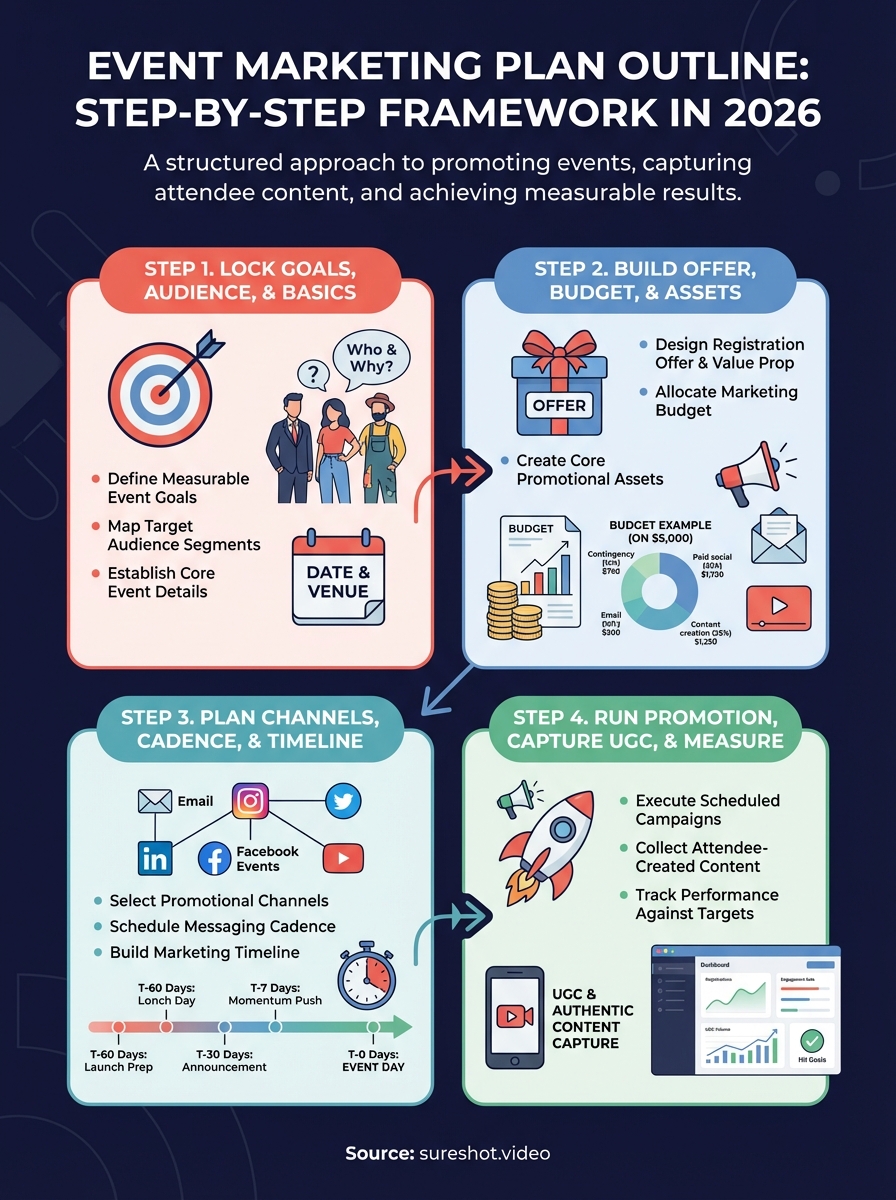
The first step in your event marketing plan outline establishes the foundation that guides every subsequent decision. You need to document exactly what you're trying to achieve, who needs to show up, and the essential details that shape your messaging. Skipping this step means you'll build promotional campaigns without direction, waste budget on channels that don't reach your audience, and struggle to measure whether your marketing actually worked. Spend time getting these three elements right before you move forward.
Define measurable event goals
Write down three to five specific outcomes you want your event to achieve within the next 30 days. Vague goals like "increase brand awareness" don't give you actionable targets. Instead, aim for concrete numbers such as "sell 500 tickets by March 15" or "generate 100 qualified leads for our sales team." Each goal should connect directly to a business objective, whether that's revenue, pipeline growth, community building, or product education. Document both your target number and the deadline for hitting it so you can track progress throughout your promotional campaign.
Lock measurable goals first so every marketing decision can be evaluated against whether it moves you closer to those specific numbers.
Map your target audience segments
Identify who needs to attend for your event to succeed, then break that audience into two or three distinct segments. A tech conference might target developers, engineering managers, and CTOs, each with different pain points and motivations. For each segment, document their demographics, where they spend time online, what content formats they prefer, and what specific value your event delivers to them. This information determines which promotional channels you'll prioritise and how you'll customise messaging for each group. If one segment lives on LinkedIn while another prefers Instagram, your channel strategy needs to reflect that split.
Establish core event details
Lock down the non-negotiable facts that anchor all your promotional content: event name, date, time, location or platform, duration, and registration deadline. These details need to stay consistent across every email, social post, landing page, and advertisement you create. Also decide your event hashtag, shortened URL for tracking, and any speaker or performer names you can announce early. Store this information in a shared document that everyone on your marketing team can reference. You'll use these details repeatedly as you build out your promotional assets in the next step.
Step 2. Build your offer, budget, and assets
This step transforms your event marketing plan outline from abstract strategy into tangible resources and financial commitments. You need to craft what attendees actually receive when they register, determine how much money flows to each marketing channel, and produce the core content pieces that drive your promotional campaigns. These three components work together because your offer determines what assets you need to create, and your budget dictates which channels can distribute those assets effectively.
Design your registration offer and value proposition
Outline exactly what attendees get in exchange for registering or buying a ticket, then package that into a single compelling sentence. This goes beyond listing basic event details. Include specific benefits like access to exclusive speakers, networking opportunities, downloadable resources, or post-event video recordings. A music festival might offer "early access to limited merchandise plus exclusive behind-the-scenes content from performers." A corporate conference could promise "direct Q&A sessions with industry leaders plus lifetime access to session recordings." Your value proposition needs to answer the question "why should someone spend time or money on this event instead of doing something else?" Write three variations of your core message so you can test which one resonates best across different channels.
Allocate your marketing budget
Break down how much money you'll invest in each promotional channel based on where your target audience spends time and which tactics have worked for similar events in the past. Start with your total available marketing budget, then assign percentages to categories like paid advertising, email tools, content creation, influencer partnerships, and user-generated content collection tools.
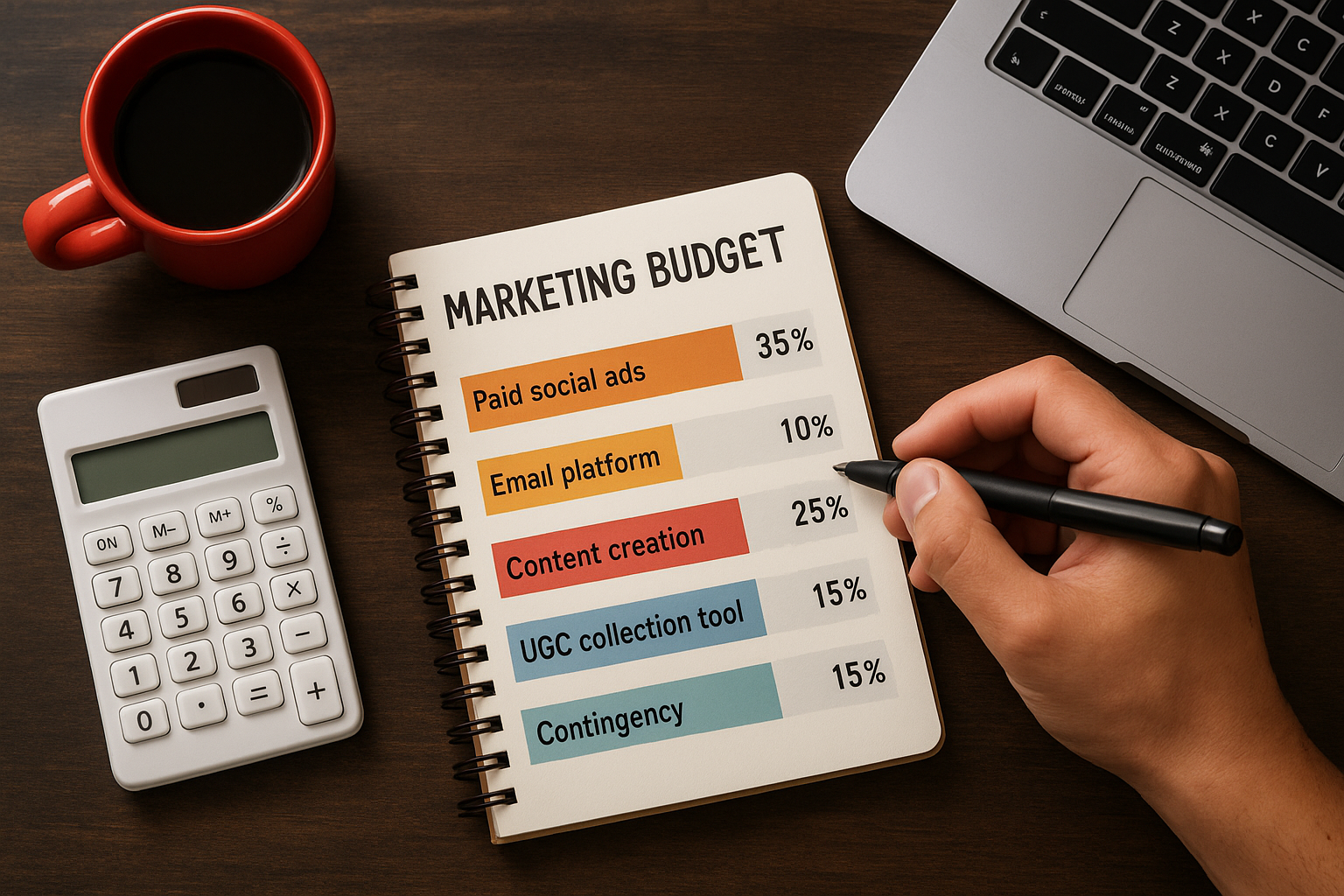
| Budget Category | Percentage | Example Amount (on $5,000 budget) |
|---|---|---|
| Paid social ads | 35% | $1,750 |
| Email platform | 10% | $500 |
| Content creation | 25% | $1,250 |
| UGC collection tool | 15% | $750 |
| Contingency | 15% | $750 |
Allocate 10-15% for contingency because you'll discover new promotional opportunities once your campaign launches that require quick budget decisions.
Reserve at least 15% for capturing and managing attendee-created content if you plan to use that footage for future marketing. Tools like SureShot enable you to collect video clips from attendees during your event, which become promotional assets for your next campaign at a fraction of traditional video production costs.
Create your core promotional assets
List every piece of content your marketing team needs to produce before launch day, then assign creation deadlines for each item. Your asset list typically includes a registration landing page, email templates for different audience segments, social media graphics in multiple sizes, speaker or performer highlight videos, and pre-written posts for various platforms. Also plan how you'll capture content during the event itself by preparing attendee instructions for submitting videos, setting up branded photo opportunities, and scheduling live streams or story updates. Build these assets in batches so your design stays consistent across all channels.
Step 3. Plan channels, cadence, and timeline
This step converts your event marketing plan outline into a coordinated schedule that controls when and where your promotional messages appear. You need to select which platforms will carry your content, determine how often you'll publish to each one, and map every marketing activity against a calendar that counts down to event day. These three elements work together because publishing great content on the wrong channel at the wrong time wastes both effort and budget.
Select your promotional channels
Choose three to five platforms where your target audience actively spends time rather than trying to maintain a presence everywhere. Look at where similar events successfully promoted themselves and where your audience segments told you they prefer to consume content. A B2B conference might prioritise LinkedIn, email, and industry forums, while a music festival focuses on Instagram, TikTok, and streaming platforms.
| Channel Type | Best For | Typical Role |
|---|---|---|
| Registered users, past attendees | Direct conversion driver | |
| Instagram/TikTok | Visual events, younger audiences | Awareness and excitement |
| Professional events, B2B | Lead generation | |
| Facebook Events | Community gatherings | Local awareness |
| YouTube | Educational content, speakers | Authority building |
Schedule your messaging cadence
Map how many times per week you'll post to each selected channel based on platform norms and your content production capacity. Instagram might support daily stories and three feed posts per week, while LinkedIn performs better with two thoughtful posts weekly. Plan your email sequence with specific send dates: one announcement email when registration opens, reminder emails at the two-week and three-day marks, and a final day-of email with joining instructions. Your cadence should increase as you approach event day to maintain momentum without overwhelming your audience.
Increase posting frequency by 50% in the final week before your event to capture last-minute registrations and build anticipation.
Build your marketing timeline
Create a reverse calendar that starts with event day and works backward to identify when each promotional activity must launch. Your timeline should include content creation deadlines, asset approval dates, paid campaign start dates, and partner announcement schedules. Block out time for collecting user-generated content during the event itself and schedule post-event follow-up activities within 48 hours while engagement remains high. Export this timeline into a shared calendar that your entire team can access and update as deadlines shift.
Step 4. Run promotion, capture UGC, and measure
This step activates everything you planned in the previous phases and transforms your event marketing plan outline from document into results. You shift from preparation to execution mode, launching campaigns according to your timeline, collecting authentic content from attendees during the event, and tracking whether your efforts hit the targets you established in step one. The quality of your execution here determines whether your event reaches capacity or falls short, so treat this phase as the most critical period in your entire marketing cycle.
Execute your scheduled campaigns
Launch each promotional activity exactly when your timeline says it should go live, starting with your announcement campaign and continuing through event day. Publish social media posts according to your planned cadence, send emails on their designated dates, and activate paid advertising campaigns at the budget levels you allocated. Monitor engagement metrics daily to spot which messages resonate and which channels underperform. If your Instagram stories generate twice the response of your feed posts, shift more content toward stories for the remainder of your campaign. Keep your messaging consistent across all platforms but adjust tactics based on real-time performance data rather than sticking rigidly to a plan that isn't working.
Collect attendee-created content
Set up your video collection system before the event starts so attendees can submit clips from the moment they arrive until the last session ends. Tools like SureShot make this process seamless by providing attendees with a dedicated PIN they enter to upload videos directly from their phones. Place clear instructions at registration, on event signage, and in any event apps explaining how and when to capture moments. Request specific content types like speaker reactions, crowd energy shots, or behind-the-scenes footage rather than leaving everything to chance.
Capturing attendee video during your event builds an authentic content library that costs a fraction of professional production while generating higher engagement rates.
Track performance against targets
Compare your current numbers to the success metrics you defined in step one at least every three days throughout your promotional period. Build a simple tracking spreadsheet that shows target versus actual for registrations, email open rates, social engagement, and any other primary metrics. Calculate which channels deliver the lowest cost per registration so you know where to invest additional budget if you need a final push before event day. Document what worked and what failed because these insights become the foundation for your next event marketing plan outline.
Wrap-up and what to do next
Your event marketing plan outline now includes every decision point and execution phase required to promote your event successfully. You've mapped your goals and audience, allocated budget across channels, scheduled promotional activities, and planned how to capture attendee content during the event itself. The difference between events that fill to capacity and those that struggle comes down to following this structured approach rather than improvising as deadlines approach.
Start by documenting your goals and target metrics this week, then move through each subsequent step at least 60 days before your event date. Build extra time into your schedule for asset creation and campaign testing because delays always happen. The most successful event organizers capture authentic video content from attendees to fuel their next promotional cycle at minimal cost.
Ready to collect powerful user-generated video from your next event? Book a demo with SureShot to see how easy attendee video collection becomes when you have the right system in place.