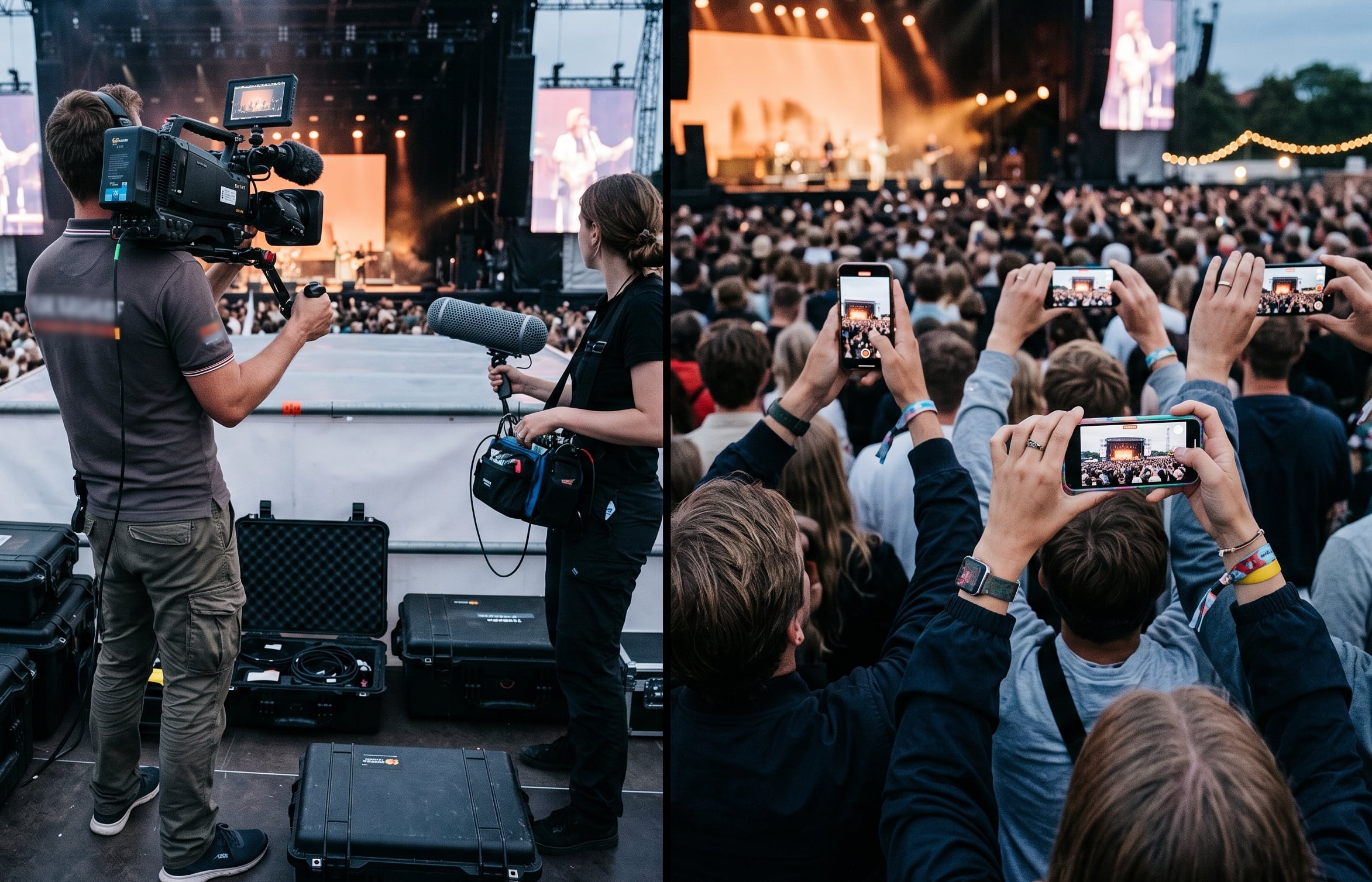


The UK runs over 1,100 music festivals every year. Glastonbury alone draws 200,000 people. Latitude, Download, Green Man, Bluedot, End of the Road, TRNSMT: the list is long and the total attendance across all of them runs into millions. That's an enormous volume of attendees who are already filming everything, and an almost complete absence of infrastructure to capture what they create.
For festival organisers, this is not a content gap. It's a missed commercial opportunity with a well-understood solution.
Glastonbury: the market proof point
Glastonbury Festival has 200,000 attendees across five days in late June. It sells out within minutes of going on sale, year after year, without needing to announce its lineup first. That's brand power built entirely on reputation, and a significant portion of that reputation travels via attendee footage.
The Pyramid Stage moment. The Legends slot. The Arcadia spider. The view from the Park Stage hill at sunset. None of these are things a production crew staged. They happened, people filmed them, and those clips spread because they were real. Glastonbury has benefited from this for years without formally structuring it.
At 200,000 attendees, even a 3% app download rate produces 6,000 active contributors. At 10%, that's 20,000. The footage from a single Glastonbury weekend, if properly collected and curated, would sustain a full year of social content for the festival and every brand partner associated with it.

Latitude: the mid-scale benchmark
Latitude Festival in Suffolk draws around 40,000 people annually and is widely considered one of the best-run festivals in the UK. Arts programming, comedy, theatre, literature: the lineup extends well beyond music into content that creates different filming behaviour from a standard rock festival.
Latitude's crowd is engaged, educated, and digitally active. They share footage from the festival with genuine enthusiasm because the event consistently delivers on its promise. The organiser's job is to make collecting and curating that footage as easy as sharing it already is.
Latitude also represents the mid-market case study. At 40,000 attendees, the content volume is significant without being overwhelming. Collection and curation are manageable. The return on a platform investment is clear and defensible.
Green Man: niche depth
Green Man Festival in the Brecon Beacons draws around 25,000 people to the Welsh mountains for a lineup that consistently punches above its size in quality. The setting is spectacular: mountain backdrop, multiple stages across a valley, and a crowd that's passionately loyal.
Green Man is a useful case study because the attendee investment is unusually high. People don't stumble into Green Man. They make a deliberate choice, often return year after year, and arrive genuinely excited. That emotional investment produces footage with a different character: more personal, more specific, more likely to make someone who wasn't there feel like they missed something important.
That "you had to be there" quality is the hardest thing to manufacture in festival marketing. Attendee footage from Green Man delivers it for free. Collecting it systematically is the obvious next step.
Download and Supersonic: volume and intensity
Download Festival at Donington Park brings 100,000 rock and metal fans together across three days. The footage created at Download is intense, specific, and community-driven. Rock and metal audiences film with a particular energy: mosh pits, crowd surfers, wall-of-death moments, the instant a riff drops and the pit opens.
This is footage that performs extremely well on short-form social platforms when properly collected and edited. Download's challenge is not getting people to film. It's surfacing the best of what they're already creating.
Supersonic Festival in Birmingham operates at the opposite end of the scale: around 2,000 attendees, experimental and avant-garde programming, deeply engaged community. The footage from Supersonic is different in character but equally valuable to the festival's positioning and ongoing audience development.
TRNSMT and the Scottish market
TRNSMT in Glasgow draws 50,000 people to Glasgow Green and has quickly become the leading Scottish festival in terms of commercial scale and lineup ambition. The crowd is young, digitally active, and films everything. The urban location means clips reach audiences before acts have even finished their sets.
Scotland represents a distinct market within the UK festival landscape. Strong local identity makes geo-specific footage particularly valuable for sponsors looking to reach Scottish audiences efficiently.
The UK opportunity in numbers
| Festival | Attendance | Location | Genre focus |
|---|---|---|---|
| Glastonbury | 200,000 | Somerset | Multi-genre |
| Download | ~100,000 | Donington, Leicestershire | Rock / metal |
| TRNSMT | ~50,000 | Glasgow | Pop / indie / rock |
| Latitude | ~40,000 | Suffolk | Multi-arts |
| Green Man | ~25,000 | Brecon Beacons | Indie / folk |
| Supersonic | ~2,000 | Birmingham | Experimental |
What the UK market proves about attendee footage
The UK festival industry is mature enough that most organisers understand the content opportunity in theory. The gap is execution. Professional video crews cost £15,000–30,000 per event and capture a fraction of what actually happens. Meanwhile, tens of thousands of attendees are filming continuously and sharing nothing back to the organiser.
The festivals that close this gap, that make it easy for attendees to submit footage, manage rights cleanly, and curate and publish in near real-time, build a content advantage that compounds. Post-event clips drive anticipation for the following year. Sponsor footage gets distributed through authentic attendee channels rather than paid placements. This is the case for a proper festival UGC strategy: not a nice-to-have, but the infrastructure that separates events with compounding marketing returns from those starting from scratch every year.
The argument isn't whether attendee footage works. It's whether you have the infrastructure to capture it systematically. SureShot is built specifically for that. Book a demo to see how it works.